Application
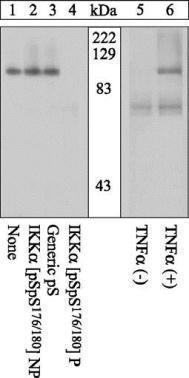
Western blot analysis on Daudi cell lysates using anti-Phospho-NF-kappa-B (pS529) RabMAb. Cells were either (A) untreated (B) treated with Calyculin A and TNF-alpha.| Product Name | IKK alpha (phospho Ser176/Ser180) antibody |
|---|---|
| Antibody Type | Primary Antibodies |
| Product description | Rabbit polyclonal to IKK alpha (phospho S176 + S180)Nuclear factor kappa B (NFkB) is a ubiquitous transcription factor and an essential mediator of gene expression during activation of immune and inflammatory responses. NFkB mediates the expression of a great variety of genes in response to extracellular stimuli including IL1, TNFa, and bacteria product LPS. NFkB is associated with IkB proteins in the cell cytoplasm, which inhibit NFkB activity. IKK is a serine protein kinase, and the IKK complex contains alpha and beta subunits (IKK alpha and IKK beta). IKK alpha and IKK beta interact with each other and both are essential for the NFkB activation. IKK alpha specifically phosphorylates IkBa. IKKa is expressed in variety of human tissues. |
| Immunogen | Synthetic phosphopeptide derived from the region of human IKK alpha that contains serine 176 and 180. |
| Modification | p-Ser176/Ser180 |
| Clonality | Polyclonal |
|---|---|
| Isotype | IgG |
| Host Species | Rabbit |
| Tested Applications | WB |
| WB: Use at a concentration of 0.5 - 1.5 μg/ml. Predicted molecular weight: 85 kDa. When looking at the phosphorylation of endogenous proteins, we recommend that IKKalpha first be immunoprecipitated. Optimal dilutions/concentrations should be determined by the end user.: |
|
| Species Reactivity | HumanMouse |
| Concentration | 1mg/ml |
| Purification | Affinity purified |
| Gene Synonyms | IKBKA IKK-alpha IKK1 IKKA NFKBIKA TCF16 IKK alpha IKKalpha IKK alpha (phospho S176) IKK alpha (phospho Ser176) IKK alpha (pS176) IKK alpha (pSer176) IKK alpha phospho S176 IKK alpha phospho Ser176 Phospho IKK alpha (S176) Phospho IKK alpha ( |
|---|---|
| Target | IKK alpha |
Application
Western blot analysis on Daudi cell lysates using anti-Phospho-NF-kappa-B (pS529) RabMAb. Cells were either (A) untreated (B) treated with Calyculin A and TNF-alpha.| Application Notes | WB: Use at a concentration of 0.5 - 1.5 μg/ml. Predicted molecular weight: 85 kDa. When looking at the phosphorylation of endogenous proteins, we recommend that IKKalpha first be immunoprecipitated. Optimal dilutions/concentrations should be determined by the end user.: |
|---|
| Form | Liquid |
|---|---|
| Storage Instructions | Keep as concentrated solution. Store at 4ºC short term. For extended storage aliquot and store at -20ºC or below. Avoid freeze-thaw cycles. |
| Storage Buffer | Preservative: 0.05% Sodium Azide. Constituents: PBS (without Mg2+ and Ca2+), 1mg/ml BSA. pH 7.3 |


