Application
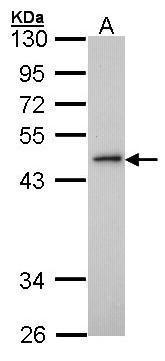
Sample (30 ug of whole cell lysate) A: H1299 10% SDS PAGE diluted at 1:1000| Product Name | ING3 antibody |
|---|---|
| Antibody Type | Primary Antibodies |
| Product description | Rabbit polyclonal antibody to ING3 (inhibitor of growth family, member 3)The protein encoded by this gene is similar to ING1, a tumor suppressor protein that can interact with TP53, inhibit cell growth, and induce apoptosis. This protein contains a PHD-finger, which is a common motif in proteins involved in chromatin remodeling. This gene can activate p53 trans-activated promoters, including promoters of p21/waf1 and bax. Overexpression of this gene has been shown to inhibit cell growth and induce apoptosis. Allelic loss and reduced expression of this gene were detected in head and neck cancers. Two alternatively spliced transcript variants encoding different isoforms have been observed. [provided by RefSeq] |
| Immunogen | Carrier-protein conjugated synthetic peptide encompassing a sequence within the center region of human ING3. The exact sequence is proprietary. |
| Clonality | Polyclonal |
|---|---|
| Isotype | IgG |
| Host Species | Rabbit |
| Tested Applications | WB |
| *Optimal dilutions/concentrations should be determined by the researcher.
: |
|
| Species Reactivity | Human |
| Predicted Reactivity | Mouse, Rat, Pig, BovineMouse (100%), Rat (100%), Pig (100%), Bovine (100%) |
| Concentration | 1mg/ml (Please refer to the vial label for the specific concentration) |
| Purification | Affinity purified |
| Gene Synonyms | Eaf4 antibody FLJ20089 antibody ING2 antibody MEAF4 antibody p47ING3 antibody ING3 antibody inhibitor of growth protein 3 antibody "inhibitor of growth family member 3 antibody" |
|---|---|
| Target | ING3 |
| Molecular Weight(MW) | 47 kDa (note) |
| Cellular Localization | Nucleus |
Application
Sample (30 ug of whole cell lysate) A: H1299 10% SDS PAGE diluted at 1:1000| Positive Control | H1299 , HepG2 |
|---|---|
| Application Notes | *Optimal dilutions/concentrations should be determined by the researcher.
: |
| Form | Liquid |
|---|---|
| Storage Instructions | Keep as concentrated solution. Aliquot and store at -20ºC or below. Avoid multiple freeze-thaw cycles. |
| Storage Buffer | 1XPBS, 40% Glycerol (pH7). 0.01% Thimerosal was added as a preservative. |


