Application
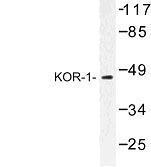
Western Blot: KOR-1 Antibody [ - Western blot (WB) analysis of KOR-1 (R361) antibody in extracts from COS-7 cells.| Product Name | Kappa Opioid receptor antibody |
|---|---|
| Antibody Type | Primary Antibodies |
| Product description | Rabbit polyclonal antibody to Kappa Opioid receptorOpioid is the term used to designate a group of compounds that are opium-like in their properties. These drugs have effects on perception of pain, consciousness, motor control, mood, and autonomic function, and can induce physical dependence. Pharmacological studies suggested that there are at least 3 major classes of opioid receptors, designated delta, kappa, and mu. They differ in their affinity for various opioid ligands and in their cellular distribution. Studies of the receptors in the mouse and rat show that they are structurally related and are members of the family of 7 transmembrane-spanning G protein-coupled receptors. The kappa opiod receptor inhibits neurotransmitter release by reducing calcium ion currents and increasing potassium ion conductance. It is the receptor for beta-endorphin. |
| Clonality | Polyclonal |
|---|---|
| Isotype | IgG |
| Host Species | Rabbit |
| Tested Applications | ELISAWB |
| We recommend the following starting dilutions: ELISA 1:1000-1:5000, Western Blot 1:500-1:1000,. Optimal concentration should be determined experimentally by the end user.: |
|
| Species Reactivity | HumanMouseMonkeyRat |
| Concentration | 1mg/ml (Please refer to the vial label for the specific concentration) |
| Purification | Affinity purified |
| Gene Synonyms | KOR-1 KOR1 Opioid Receptor 4986 29335 OPRK1 Kappa-1 Kappa1 498629335 KOR 1 Kappa 1 |
|---|---|
| Target | Kappa Opioid receptor |
| Tissue Specificity | KOR-1 (R361) detects endogenous levels of KOR-1 protein. |
Application
Western Blot: KOR-1 Antibody [ - Western blot (WB) analysis of KOR-1 (R361) antibody in extracts from COS-7 cells.| Application Notes | We recommend the following starting dilutions: ELISA 1:1000-1:5000, Western Blot 1:500-1:1000,. Optimal concentration should be determined experimentally by the end user.: |
|---|
| Form | Liquid |
|---|---|
| Storage Instructions | Store at 4C short term. Aliquot and store at -20C long term. Avoid freeze-thaw cycles. |
| Storage Buffer | Phosphate buffered saline, pH 7.2. |


