Application
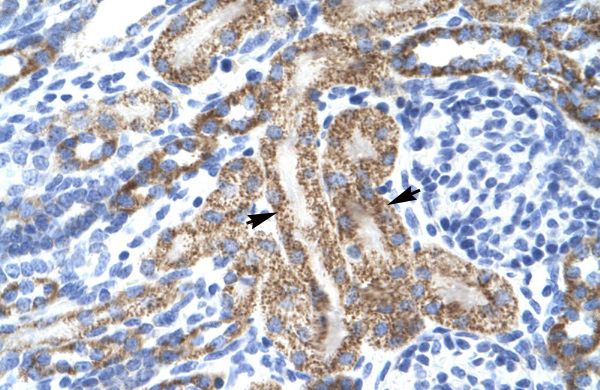
IHC-P analysis of human kidney tissue using KCNA10 antibody at 4.0-8.0μg/ml.Application
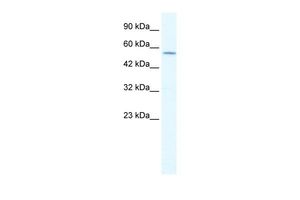
WB analysis of Jurkat cells using KCNA10 antibody at 1.25μg/ml.| Product Name | KCNA10 antibody, Internal |
|---|---|
| Antibody Type | Primary Antibodies |
| Product description | Rabbit Polyclonal antibody to KCNA10Potassium channels represent the most complex class of voltage-gated ion channels from both functional and structural standpoints. Their diverse functions include regulating neurotransmitter release, heart rate, insulin secretion, neuronal excitability, epithelial electrolyte transport, smooth muscle contraction, and cell volume. Four sequence-related potassium channel genes - shaker, shaw, shab, and shal - have been identified in Drosophila, and each has been shown to have human homolog(s). This gene encodes a member of the potassium channel, voltage-gated, shaker-related subfamily. This member contains six membrane-spanning domains with a shaker-type repeat in the fourth segment. It is specifically regulated by cGMP and postulated to mediate the effects of substances that increase intracellular cGMP. This gene is intronless, and the gene is clustered with genes KCNA2 and KCNA3 on chromosome 1. [provided by RefSeq, Jul 2008] |
| Immunogen | A synthetic peptide corresponding to an Internal region of Human KCNA10 |
| Clonality | Polyclonal |
|---|---|
| Isotype | IgG |
| Host Species | Rabbit |
| Tested Applications | IHC-PWB |
| *Optimal dilutions/concentrations should be determined by the researcher.
: |
|
| Species Reactivity | Human |
| Predicted Reactivity | Cow: 100%; Dog: 92%; Guinea Pig: 92%; Human: 100%; Mouse: 100%; Rat: 100% |
| Concentration | 1mg/ml |
| Purification | Protein A |
| Gene Synonyms | KCN1 KV1.8 KCNA10 |
|---|---|
| Target | KCNA10 |
| Molecular Weight(MW) | 58 KDa (note) |
Application
IHC-P analysis of human kidney tissue using KCNA10 antibody at 4.0-8.0μg/ml.
Application
WB analysis of Jurkat cells using KCNA10 antibody at 1.25μg/ml.| Positive Control | Jurkat |
|---|---|
| Application Notes | *Optimal dilutions/concentrations should be determined by the researcher.
: |
| Form | Liquid |
|---|---|
| Storage Instructions | Keep as concentrated solution. For short-term storage, store at 4ºC. For long-term storage, aliquot and store at -20ºC or below. Avoid multiple freeze-thaw cycles. |
| Storage Buffer | 1x PBS buffer with 0.09% (w/v) sodium azide and 2% sucrose. |


