Application
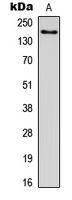
Western blot analysis of LPHN1 expression in HEK293T (A) whole cell lysates.| Product Name | Latrophilin-1 antibody |
|---|---|
| Antibody Type | Primary Antibodies |
| Product description | Rabbit Polyclonal antibody to Latrophilin-1This gene encodes a member of the latrophilin subfamily of G-protein coupled receptors (GPCR). Latrophilins may function in both cell adhesion and signal transduction. In experiments with non-human species, endogenous proteolytic cleavage within a cysteine-rich GPS (G-protein-coupled-receptor proteolysis site) domain resulted in two subunits (a large extracellular N-terminal cell adhesion subunit and a subunit with substantial similarity to the secretin/calcitonin family of GPCRs) being non-covalently bound at the cell membrane. Latrophilin-1 has been shown to recruit the neurotoxin from black widow spider venom, alpha-latrotoxin, to the synapse plasma membrane. Alternative splicing results in multiple variants encoding distinct isoforms.[provided by RefSeq, Oct 2008] |
| Immunogen | KLH-conjugated synthetic peptide encompassing a sequence within the center region of human LPHN1. The exact sequence is proprietary. |
| Clonality | Polyclonal |
|---|---|
| Isotype | IgG |
| Host Species | Rabbit |
| Tested Applications | WB |
| WB: 1:500 - 1:1000: |
|
| Species Reactivity | Human |
| Concentration | 1mg/ml |
| Purification | Affinity purified |
| Gene Synonyms | LPHN1 CL1 CIRL1 LEC2 latrophilin 1 |
|---|---|
| Target | Latrophilin-1 |
| Tissue Specificity | Recognizes endogenous levels of LPHN1 protein. |
Application
Western blot analysis of LPHN1 expression in HEK293T (A) whole cell lysates.| Application Notes | WB: 1:500 - 1:1000: |
|---|
| Form | Liquid |
|---|---|
| Storage Instructions | Shipped at 4 C. Upon delivery aliquot and store at -20 C for one year. Avoid freeze/thaw cycles. |
| Storage Buffer | Liquid in 0.42% Potassium phosphate, 0.87% Sodium chloride, pH 7.3, 30% glycerol, and 0.01% sodium azide. |


