Application
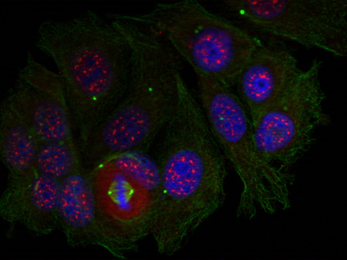
Immunofluorescence staining of methanol-fixed Hela cells using MEF2A (Phospho-Thr319) Antibody| Product Name | MEF2A (phospho Thr319) antibody |
|---|---|
| Antibody Type | Primary Antibodies |
| Product description | Rabbit Polyclonal antibody to MEF2A (Phospho Thr319)The process of differentiation from mesodermal precursor cells to myoblasts has led to the discovery of a variety of tissue-specific factors that regulate muscle gene expression. The myogenic basic helix-loop-helix proteins, including myoD (MIM 159970), myogenin (MIM 159980), MYF5 (MIM 159990), and MRF4 (MIM 159991) are one class of identified factors. A second family of DNA binding regulatory proteins is the myocyte-specific enhancer factor-2 (MEF2) family. Each of these proteins binds to the MEF2 target DNA sequence present in the regulatory regions of many, if not all, muscle-specific genes. The MEF2 genes are members of the MADS gene family (named for the yeast mating type-specific transcription factor MCM1, the plant homeotic genes 'agamous' and 'deficiens' and the human serum response factor SRF (MIM 600589)), a family that also includes several homeotic genes and other transcription factors, all of which share a conserved DNA-binding domain |
| Immunogen | Peptide sequence around phosphorylation site of Thr319 (V-T-T(p)-P-S) derived from Human MEF2A. |
| Modification | p-Thr319 |
| Clonality | Polyclonal |
|---|---|
| Host Species | Rabbit |
| Tested Applications | ICC/IF |
| Suggested starting dilutions are as follows. ICC/IF: 1:100~1:200. Not yet tested in other applications. Optimal working dilutions should be determined experimentally by the end user.: |
|
| Species Reactivity | HumanMouseRat |
| Concentration | 1mg/ml (Please refer to the vial label for the specific concentration) |
| Purification | Affinity purified |
| Gene Synonyms | ADCAD1 RSRFC4 RSRFC9 MEF2A serum response factor-like protein 1 myocyte-specific enhancer factor 2A MADS box transcription enhancer factor 2 polypeptide A (myocyte enhancer factor 2A) myocyte enhancer factor 2A |
|---|---|
| Target | MEF2A (Phospho Thr319) |
| Molecular Weight(MW) | 54 (note) |
Application
Immunofluorescence staining of methanol-fixed Hela cells using MEF2A (Phospho-Thr319) Antibody| Application Notes | Suggested starting dilutions are as follows. ICC/IF: 1:100~1:200. Not yet tested in other applications. Optimal working dilutions should be determined experimentally by the end user.: |
|---|
| Form | Liquid |
|---|---|
| Storage Instructions | Keep as concentrated solution. Aliquot and store at -20ºC or below. Avoid multiple freeze-thaw cycles. |
| Storage Buffer | saline (without Mg2+ and Ca2+), pH 7.4, 150mM NaCl, 0.02% sodium azide and 50% glycerol. |


