Application
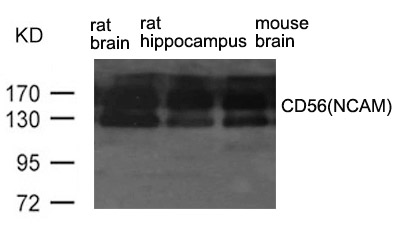
Western blot analysis of extract from rat brain, rat hippocampus and mouse brain using CD56 (NCAM) Antibody| Product Name | NCAM antibody |
|---|---|
| Antibody Type | Primary Antibodies |
| Product description | Rabbit Polyclonal antibody to NCAMNCAM (neural cell adhesion molecule, CD56) is an adhesion glycoprotein with five extracellular immunoglobulin-like domains followed by two fibronectin type III repeats. Structural diversity is introduced by alternative splicing resulting in different cytoplasmic domains (1). NCAM mediates neuronal attachment, neurite extension and cell-cell interactions through homo and heterophilic interactions. PSA (polysialic acid) post-translationally modifies NCAM and increases the metastatic potential of small cell lung carcinoma, Wilms+ tumor, neuroblastoma and rhabdomyosarcoma (2). CD56 and CD16 are commonly used to identify NK cells although some cells with the T cell markers CD3 and CD4 also express CD56 (3). |
| Immunogen | Peptide sequence around aa.850~854(Q-T-K-E-N)derived from Human CD56(NCAM). |
| Clonality | Polyclonal |
|---|---|
| Host Species | Rabbit |
| Tested Applications | WB |
| Suggested starting dilutions are as follows. WB: 1:500~1:1000. Not yet tested in other applications. Optimal working dilutions should be determined experimentally by the end user.: |
|
| Species Reactivity | HumanMouse |
| Concentration | 1mg/ml (Please refer to the vial label for the specific concentration) |
| Purification | Affinity purified |
| Gene Synonyms | CD56 MSK39 NCAM NCAM1 NCAM-1 neural cell adhesion molecule 1 N-CAM-1 antigen recognized by monoclonal antibody 5.1H11 neural cell adhesion molecule NCAM |
|---|---|
| Target | NCAM) |
| Molecular Weight(MW) | 120-220 (note) |
Application
Western blot analysis of extract from rat brain, rat hippocampus and mouse brain using CD56 (NCAM) Antibody| Application Notes | Suggested starting dilutions are as follows. WB: 1:500~1:1000. Not yet tested in other applications. Optimal working dilutions should be determined experimentally by the end user.: |
|---|
| Form | Liquid |
|---|---|
| Storage Instructions | Keep as concentrated solution. Aliquot and store at -20ºC or below. Avoid multiple freeze-thaw cycles. |
| Storage Buffer | saline (without Mg2+ and Ca2+), pH 7.4, 150mM NaCl, 0.02% sodium azide and 50% glycerol. |


