Application
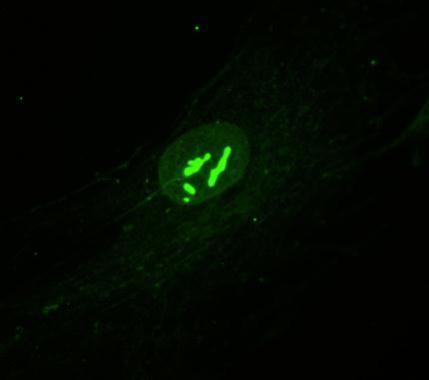
Methanol/Acetone (1:1) fixed human dermal fibroblasts (HDF) stained with anti-Nesprin-1 C1 .| Product Name | Nesprin 1 antibody |
|---|---|
| Antibody Type | Primary Antibodies |
| Product description | Rabbit Polyclonal antibody to Nesprin 1There are two genes encoding members of a new family of type II integral membrane proteins. Both are ubiquitously expressed, and tissue-specific alternative mRNA initiation and splicing generate at least two major isoforms of each protein, with the smaller isoforms being truncated at the N-terminus.These proteins are called Nesprin l and 2 for nuclear envelope spectrin repeat, as they are characterized by the presence of multiple, clustered spectrin repeats, bipartite nuclear localization sequences and a conserved C-terminal, single transmembrane domain. Transient transfection of EGFP-fusion expression constructs demonstrated their localization to the nuclear membrane with a novel C-terminal, TM domain-containing sequence essential for perinuclear localization. Nesprin l is developmentally regulated in both smooth and skeletal muscle and is relocalized from the nuclear envelope to the nucleus and cytoplasm during C2Cl2 myoblast differentiation. Nesprins may function as "dystrophins of the nucleus" to maintain nuclear organization and structural integrity. There are two genes encoding members of a new family of type II integral membrane proteins. Both are ubiquitously expressed, and tissue-specific alternative mRNA initiation and splicing generate at least two major isoforms of each protein, with the smaller isoforms being truncated at the N-terminus.These proteins are called Nesprin l and 2 for nuclear envelope spectrin repeat, as they are characterized by the presence of multiple, clustered spectrin repeats, bipartite nuclear localization sequences and a conserved C-terminal, single transmembrane domain. Transient transfection of EGFP-fusion expression constructs demonstrated their localization to the nuclear membrane with a novel C-terminal, TM-domain-containing sequence essential for perinuclear localization. Nesprin l is developmentally regulated in both smooth and skeletal muscle and is relocalized from the nuclear envelope to the nucleus and cytoplasm during C2Cl2 myoblast differentiation. Nesprins may function as "dystrophins of the nucleus" to maintain nuclear organization and structural integrity. |
| Immunogen | Synthetic polypeptide GRSTPNRQKTPRGKC residues 3212-3226)conjugated to KLH |
| Clonality | Polyclonal |
|---|---|
| Isotype | IgG |
| Host Species | Rabbit |
| Tested Applications | ICC/IFIHC-FWB |
| For WB: Use at 1:500-1:750: |
|
| Species Reactivity | Human |
| Concentration | 1mg/ml |
| Purification | Affinity purified |
| Gene Synonyms | 8B ARCA1 C6orf98 CPG2 DKFZp781J13156 EDMD4 FLJ30878 FLJ41140 KIAA0796 KIAA1262 KIAA1756 MYNE1 SCAR8 dJ45H2.2 |
|---|---|
| Target | Nesprin 1 |
| Tissue Specificity | Reacts with human nesprin 1 |
| Cellular Localization | The largest part of the protein is cytoplasmic, while its C-terminal part is associated with the nuclear envelope, most probably the outer nuclear membrane. In skeletal and smooth muscles, a significant amount is found in the sarcomeres. |
Application
Methanol/Acetone (1:1) fixed human dermal fibroblasts (HDF) stained with anti-Nesprin-1 C1 .| Application Notes | For WB: Use at 1:500-1:750: |
|---|
| Form | Liquid |
|---|---|
| Storage Instructions | Store at 2-8°C. For extended storage, aliquot and store at -20°C. Avoid repeated freeze-thaw cycles. |
| Storage Buffer | PBS + 0.1% sodium azide |


