Application
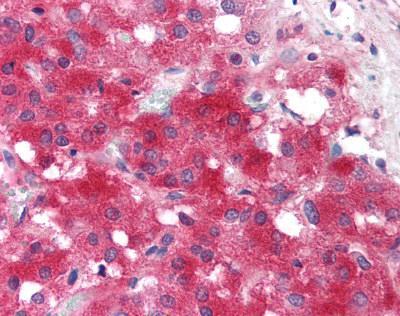
Human Adrenal Medulla (formalin-fixed, paraffin-embedded) stained with NRG3 antibody at 20 ug/ml followed by biotinylated goat anti-rabbit IgG secondary antibody LS-D1, alkaline phosphatase-streptavidin and chromogen.| Product Name | NRG3 antibody |
|---|---|
| Antibody Type | Primary Antibodies |
| Product description | Rabbit polyclonal antibody to NRG3This gene is a member of the neuregulin gene family. This gene family encodes ligands for the transmembrane tyrosine kinase receptors ERBB3 and ERBB4 - members of the epidermal growth factor receptor family. Ligand binding activates intracellular signaling cascades and the induction of cellular responses including proliferation, migration, differentiation, and survival or apoptosis. This gene encodes neuregulin 3 (NRG3). NRG3 has been shown to activate the tyrosine phosphorylation of its cognate receptor, ERBB4, and is thought to influence neuroblast proliferation, migration and differentiation by signalling through ERBB4. NRG3 also promotes mammary differentiation during embryogenesis. Linkage studies have implicated this gene as a susceptibility locus for schizophrenia and schizoaffective disorder. Alternative splicing results in multiple transcript variants encoding distinct isoforms. Additional transcript variants have been described but their biological validity has not been verified. |
| Immunogen | Synthetic peptide - KLH conjugated |
| Clonality | Polyclonal |
|---|---|
| Host Species | Rabbit |
| Tested Applications | ELISAIHC-P |
| ELISA (1:0 - 1:1000), IHC-P (20 µg/ml): |
|
| Species Reactivity | Human |
| Concentration | 1mg/ml (Please refer to the vial label for the specific concentration) |
| Gene Synonyms | HRG3 pro-NRG3 NRG 3 pro NRG3 proNRG3 Neuregulin3 |
|---|
Application
Human Adrenal Medulla (formalin-fixed, paraffin-embedded) stained with NRG3 antibody at 20 ug/ml followed by biotinylated goat anti-rabbit IgG secondary antibody LS-D1, alkaline phosphatase-streptavidin and chromogen.| Application Notes | ELISA (1:0 - 1:1000), IHC-P (20 µg/ml): |
|---|
| Form | Liquid |
|---|---|
| Storage Instructions | Long term: -20°C; Short term: +4°C |
| Storage Buffer | PBS, 0.1% sodium azide. |


