Application
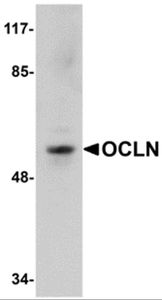
WB analysis of human liver lysate using OCLN antibody at a concentration of 1 μg/ml.| Product Name | Occludin antibody |
|---|---|
| Antibody Type | Primary Antibodies |
| Product description | Rabbit Polyclonal antibody to OccludinTight junctions act as a semi-permeable barrier to the transport of ions, solutes, and water and are considered to function as a fence that divides apical and basolateral domains of plasma membranes. Tight junctions coordinate a variety of signaling and trafficking molecules regulating cell differentiation, proliferation, and polarity and contain a number of junctional proteins including Occludin, Claudins, junctional adhesion molecules (JAMs), as well as multiple scaffold proteins. Occludin, the first identified component of tight junction strands, is thought function as a signal transmitter in multiple signaling pathways and can associate with multiple kinases and phosphatases such as PI3-kinase and protein phosphatases 1 and 2A. At least two isoforms of OCLN are known to exist. |
| Immunogen | The immunogen corresponding to a region within amino acids 472 and 522 of human OCLN. |
| Clonality | Polyclonal |
|---|---|
| Isotype | IgG |
| Host Species | Rabbit |
| Tested Applications | WB |
| This antibody can be used for detection of OCLN by Western blot at 1 μg/mL. It can also be used for immunohistochemistry starting at 2.5 μg/mL. For immunofluorescence start at 20 μg/mL.: |
|
| Species Reactivity | HumanMouseRat |
| Concentration | 1mg/ml |
| Purification | Affinity purified |
| Gene Synonyms | Occludin OCLN |
|---|---|
| Target | Occludin |
| Molecular Weight(MW) | 57 kDa (note) |
| Tissue Specificity | This antibody is specific for OCLN |
Application
WB analysis of human liver lysate using OCLN antibody at a concentration of 1 μg/ml.| Positive Control | Human Liver Tissue Lysate |
|---|---|
| Application Notes | This antibody can be used for detection of OCLN by Western blot at 1 μg/mL. It can also be used for immunohistochemistry starting at 2.5 μg/mL. For immunofluorescence start at 20 μg/mL.: |
| Form | Liquid |
|---|---|
| Storage Instructions | Keep as concentrated solution. Aliquot and store at -20ºC or below. Avoid multiple freeze-thaw cycles. |
| Storage Buffer | Antibody is supplied in PBS containing 0.02% sodium azide |


