Application
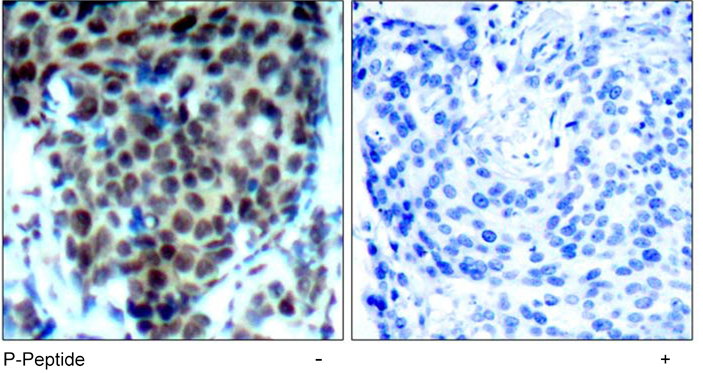
Immunohistochemical analysis of paraffin-embedded human breast carcinoma tissue using p38 MAPK (phospo-Thr180) antibody| Product Name | p38 MAPK (phospho Thr180) antibody |
|---|---|
| Antibody Type | Primary Antibodies |
| Product description | Rabbit polyclonal antibody to p38 MAPK (phospho Thr180)The protein encoded by this gene is a member of the MAP kinase family. MAP kinases act as an integration point for multiple biochemical signals, and are involved in a wide variety of cellular processes such as proliferation, differentiation, transcription regulation and development. This kinase is activated by various environmental stresses and proinflammatory cytokines. The activation requires its phosphorylation by MAP kinase kinases (MKKs), or its autophosphorylation triggered by the interaction of MAP3K7IP1/TAB1 protein with this kinase. The substrates of this kinase include transcription regulator ATF2, MEF2C, and MAX, cell cycle regulator CDC25B, and tumor suppressor p53, which suggest the roles of this kinase in stress related transcription and cell cycle regulation, as well as in genotoxic stress response. Four alternatively spliced transcript variants of this gene encoding distinct isoforms have been reported. [provided by RefSeq] |
| Modification | p-Thr180 |
| Clonality | Polyclonal |
|---|---|
| Isotype | IgG |
| Host Species | Rabbit |
| Tested Applications | IHCIHC-P |
| Suggested starting dilutions are as follows. IHC: 1:50-1:100. Not yet tested in other applications. Optimal working dilutions should be determined experimentally by the end user.: |
|
| Species Reactivity | HumanMouseRat |
| Concentration | 1mg/ml (Please refer to the vial label for the specific concentration) |
| Purification | Affinity purified |
| Gene Synonyms | CSBP1 CSBP2 CSPB1 EXIP Mxi2 PRKM14 PRKM15 RK SAPK2A p38 p38ALPHA |
|---|---|
| Target | p38 MAPK (phospho Thr180) |
Application
Immunohistochemical analysis of paraffin-embedded human breast carcinoma tissue using p38 MAPK (phospo-Thr180) antibody| Application Notes | Suggested starting dilutions are as follows. IHC: 1:50-1:100. Not yet tested in other applications. Optimal working dilutions should be determined experimentally by the end user.: |
|---|
| Form | Liquid |
|---|---|
| Storage Instructions | Keep as concentrated solution. Aliquot and store at -20ºC or below. Avoid multiple freeze-thaw cycles. |
| Storage Buffer | PBS (without Mg2+and Ca2+), pH 7.4, 150mM NaCl,0.02% sodium azide and 50% glycerol. |


