Application
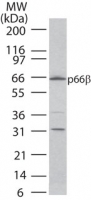
Western blot analysis of p66b in HeLa lysate using p66b antibody at 4 ug/ml.| Product Name | p66 beta antibody |
|---|---|
| Antibody Type | Primary Antibodies |
| Product description | Rabbit polyclonal to p66 betaMethylation of cytosine at CpG dinucleotides is a common feature of many higher eukaryotic genomes. Increasing evidence indicates that recruitement of histone deacetylase complexes by methyl-CpG-binding proteins (MeCP) is a major mechanism of methylated DNA silencing. P66, a zinc finger-containing protein is one of the components of the MeCP1 complex. P66 and p68, the two components of MeCP1 are different forms of the same zinc finger-containing protein and are conserved from C.elegans to humans. Homologs of p66 from different organisms revealed two highly conserved regions, CR1 and CR2. While CR1 is involved in the association of p66 with other MeCP1 components, CR2 plays an important role in targeting p66 and MBD3 to specific loci. |
| Immunogen | Synthetic peptide, corresponding to amino acids 445-460 of Mouse p66 beta . |
| Clonality | Polyclonal |
|---|---|
| Isotype | IgG |
| Host Species | Rabbit |
| Tested Applications | WB |
| WB: 2-4 ug/ml. Predicted molecular weight: 66 kDa. Optimal dilutions/concentrations should be determined by the end user.: |
|
| Species Reactivity | HumanMouse |
| Concentration | 1mg/ml |
| Purification | Protein G |
| Gene Synonyms | AL118180 C430014D17Rik KIAA1150 P66beta mKIAA1150 |
|---|---|
| Target | p66 beta |
Application
Western blot analysis of p66b in HeLa lysate using p66b antibody at 4 ug/ml.| Positive Control | Raw or HeLa whole cell lysate. |
|---|---|
| Application Notes | WB: 2-4 ug/ml. Predicted molecular weight: 66 kDa. Optimal dilutions/concentrations should be determined by the end user.: |
| Form | Liquid |
|---|---|
| Storage Instructions | Keep as concentrated solution. Store at 4ºC short term. For extended storage aliquot and store at -20ºC or below. Avoid freeze-thaw cycles. |
| Storage Buffer | Preservative: 0.02% Sodium Azide; Constituents: PBS, 0.1mg/ml BSA |


