Application
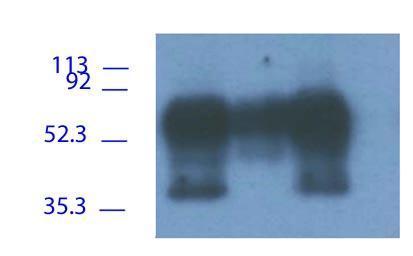
1. Frozen Raji cells lysate, immunoprecipitated with 2. Fresh Raji cells lysate, immunoprecipitated with 3. Frozen Raji cells lysate, immunoprecipitated with Reprobe with The immunoprecipitation used covalently boun| Product Name | PAG antibody |
|---|---|
| Antibody Type | Primary Antibodies |
| Product description | Rabbit polyclonal to PAGCsk binding protein, also known as PAG (phosphoprotein associated with GEMs), is a ubiquitously expressed 46 kDa transmembrane adaptor protein present in membrane rafts (glycosphingolipid-enriched microdomains), which however migrates on SDS PAGE gels anomalously as an 80 kDa molecule. Following tyrosine phosphorylation by Src family kinases, PAG binds and thereby activates the protein tyrosine kinase Csk, the major negative regulator of the Src family kinases. Signaling via the B-cell receptor in B cells or high affinity IgE receptor (FcepsilonRI) in mast cells leads to PAG increased tyrosine phosphorylation and Csk binding, while T cell receptor signaling causes PAG dephosphorylation, loss of Csk binding and increased activation of the protein tyrosine kinase Lck. |
| Immunogen | Recombinant fragment, corresponding to amino acids 97-432 of Human PAG. |
| Clonality | Polyclonal |
|---|---|
| Isotype | IgG |
| Host Species | Rabbit |
| Tested Applications | IPWB |
| IP: Use at an assay dependent dilution. WB: Use at an assay dependent dilution. Predicted molecular weight: 51.8 kDa. Optimal dilutions/concentrations should be determined by the end user.: |
|
| Species Reactivity | HumanMouse |
| Concentration | 1mg/ml (Please refer to the vial label for the specific concentration) |
| Purification | Affinity purified |
| Gene Synonyms | CBP FLJ37858 MGC138364 PAG |
|---|---|
| Target | PAG |
Application
1. Frozen Raji cells lysate, immunoprecipitated with 2. Fresh Raji cells lysate, immunoprecipitated with 3. Frozen Raji cells lysate, immunoprecipitated with Reprobe with The immunoprecipitation used covalently boun| Positive Control | Human Ramos cell lineMouse spleen cells |
|---|---|
| Application Notes | IP: Use at an assay dependent dilution. WB: Use at an assay dependent dilution. Predicted molecular weight: 51.8 kDa. Optimal dilutions/concentrations should be determined by the end user.: |
| Form | Liquid |
|---|---|
| Storage Instructions | Store at 2-8ºC. Do not freeze. Do not use after expiration date stamped on vial label. |
| Storage Buffer | Phosphate buffered saline pH 7.4 containing 15mM sodium azide |


