Application
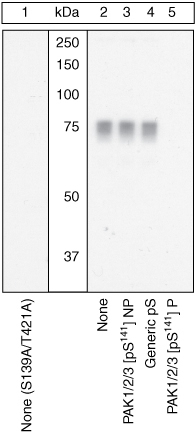
Western blot using PAK1/2/3 [pS141] polyclonal antibody, rabbit| Product Name | PAK1 + PAK2 + PAK3 (phospho Ser141) antibody |
|---|---|
| Antibody Type | Primary Antibodies |
| Product description | Rabbit polyclonal to PAK1 + PAK2 + PAK3 ( phospho S141 )P21-activated kinase (PAK) is actually a family of serine/threonine protein kinases, members of which are activated by small molecular weight GTPases. The three most common isoforms are PAK 1, PAK 2, and PAK 3 (also known as alpha PAK, gamma PAK, and beta PAK, respectively). These kinases contain numerous regulatory elements that trigger diverse signaling processes such as those initiated by activated GTPases, interaction with Src homology 3 (SH3) domains, and caspase mediated proteolytic cleavage. Autophosphorylation of serine 141 (serine 144 for PAK 1 and serine 139 PAK 3), catalyzed by Cdc42, is required for activation of PAK. |
| Immunogen | Chemically synthesized phosphopeptide derived from a region of human PAK2 that contains serine 141. The sequence is conserved in rat and rabbit. |
| Modification | p-Ser141 |
| Clonality | Polyclonal |
|---|---|
| Isotype | IgG |
| Host Species | Rabbit |
| Tested Applications | WB |
| WB: Use at a concentration of 0.1 - 1.0 μg/ml. Predicted molecular weight: 65 kDa. Optimal dilutions/concentrations should be determined by the end user.: |
|
| Species Reactivity | HumanRatRabbit |
| Concentration | 1mg/ml |
| Purification | Affinity purified |
| Gene Synonyms | MGC130000 PAK65 CDKN1A MGC130001 PAKgamma MRX30 PAKalpha MRX47 OPHN3 PAK3beta bPAK hPAK3 PAK1 + PAK2 + PAK3 (phospho S141) PAK1 + PAK2 + PAK3 (phospho Ser141) PAK1 + PAK2 + PAK3 (pS141) PAK1 + PAK2 + PAK3 (pSer141) PAK1 + PAK2 + PAK3 phosp |
|---|---|
| Target | PAK1 + PAK2 + PAK3 |
Application
Western blot using PAK1/2/3 [pS141] polyclonal antibody, rabbit| Positive Control | Cos cells transiently transfected with PAK 1, PAK 2, or PAK 3, and co transfected with V12 Cdc42 and grown either as adherent cultures to activate PAK, or placed in suspension to suppress PAK activation |
|---|---|
| Application Notes | WB: Use at a concentration of 0.1 - 1.0 μg/ml. Predicted molecular weight: 65 kDa. Optimal dilutions/concentrations should be determined by the end user.: |
| Form | Liquid |
|---|---|
| Storage Instructions | Aliquot and store at -20°C or -80°C. Avoid repeated freeze / thaw cycles. |
| Storage Buffer | Preservative: 0.05% Sodium Azide; Constituents: PBS, 50% glycerol, 1mg/ml BSA (IgG, protease free). pH 7.3 |


