Application
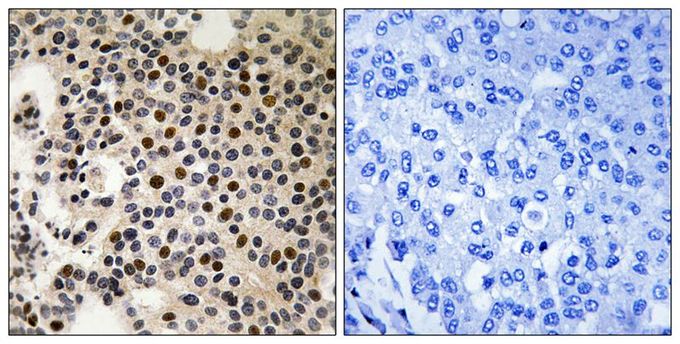
Immunohistochemical analysis of paraffin-embedded human breast carcinoma tissue, using PAK2 (Phospho-Ser197) antibody (left) or the same antibody preincubated with blocking peptide (right).| Product Name | PAK2 (phospho Ser197) antibody |
|---|---|
| Antibody Type | Primary Antibodies |
| Product description | Rabbit Polyclonal antibody to PAK2 (phospho Ser197)The p21 activated kinases (PAK) are critical effectors that link Rho GTPases to cytoskeleton reorganization and nuclear signaling. The PAK proteins are a family of serine/threonine kinases that serve as targets for the small GTP binding proteins, CDC42 and RAC1, and have been implicated in a wide range of biological activities. The protein encoded by this gene is activated by proteolytic cleavage during caspase-mediated apoptosis, and may play a role in regulating the apoptotic events in the dying cell. [provided by RefSeq, Jul 2008] |
| Immunogen | Peptide sequence around phosphorylation site of Serine 197(T-R-S(p)-V-I) derived from Human PAK2. |
| Modification | p-Ser197 |
| Clonality | Polyclonal |
|---|---|
| Isotype | IgG |
| Host Species | Rabbit |
| Tested Applications | IHC-P |
| IHC: 1:50 - 1:100: |
|
| Species Reactivity | Human |
| Concentration | 1mg/ml (Please refer to the vial label for the specific concentration) |
| Purification | Affinity purified |
| Gene Synonyms | p21 protein (Cdc42/Rac)-activated kinase 2 PAK2 PAKgamma PAK65 |
|---|---|
| Target | PAK2 (phospho Ser197) |
| Tissue Specificity | The antibody detects endogenous levels of PAK2 only when phosphorylated at serine 197. |
Application
Immunohistochemical analysis of paraffin-embedded human breast carcinoma tissue, using PAK2 (Phospho-Ser197) antibody (left) or the same antibody preincubated with blocking peptide (right).| Application Notes | IHC: 1:50 - 1:100: |
|---|
| Form | Liquid |
|---|---|
| Storage Instructions | Store at -20˚C/1 year |
| Storage Buffer | Rabbit IgG in phosphate buffered saline (without Mg2+ and Ca2+), pH 7.4, 150mM NaCl, 0.02% sodium azide and 50% glycerol. |


