Application
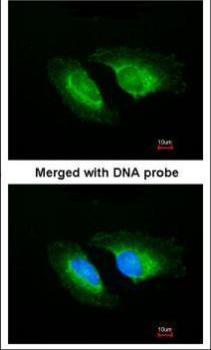
Immunofluorescence analysis of paraformaldehyde-fixed HeLa, using PRKACA antibody at 1:200 dilution.Application
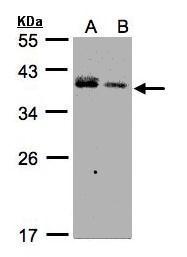
Sample(30 μg of whole cell lysate) A:H1299 B:HeLa S3 12% SDS PAGE diluted at 1:500| Product Name | PKA C alpha antibody |
|---|---|
| Antibody Type | Primary Antibodies |
| Product description | Rabbit polyclonal antibody to PKA C alpha (protein kinase, cAMP-dependent, catalytic, alpha)cAMP is a signaling molecule important for a variety of cellular functions. cAMP exerts its effects by activating the cAMP-dependent protein kinase, which transduces the signal through phosphorylation of different target proteins. The inactive kinase holoenzyme is a tetramer composed of two regulatory and two catalytic subunits. cAMP causes the dissociation of the inactive holoenzyme into a dimer of regulatory subunits bound to four cAMP and two free monomeric catalytic subunits. Four different regulatory subunits and three catalytic subunits have been identified in humans. The protein encoded by this gene is a member of the Ser/Thr protein kinase family and is a catalytic subunit of cAMP-dependent protein kinase. Alternatively spliced transcript variants encoding distinct isoforms have been observed. [provided by RefSeq] |
| Immunogen | Recombinant protein encompassing a sequence within the center region of human PKA C alpha. The exact sequence is proprietary. |
| Clonality | Polyclonal |
|---|---|
| Isotype | IgG |
| Host Species | Rabbit |
| Tested Applications | ICC/IFWB |
| *Optimal dilutions/concentrations should be determined by the researcher. | |
| Species Reactivity | Human |
| Predicted Reactivity | Mouse, Rat, Xenopus laevis, Dog, Rabbit, Sheep, BovineMouse (98%), Rat (98%), Xenopus laevis (94%), Dog (99%), Rabbit (97%), Sheep (99%), Bovine (99%) |
| Concentration | 0.2mg/ml |
| Purification | Affinity purified |
| Gene Synonyms | MGC102831 antibody, MGC48865 antibody, PKACA antibody, PRKACA antibody, protein kinase A catalytic subunit antibody, "cAMP-dependent protein kinase catalytic subunit alpha, isoform 1 antibody", cAMP-dependent protein kinase catalytic subunit alpha antibody |
|---|---|
| Target | PRKACA |
| Molecular Weight(MW) | 41 kDa (note) (2) |
| Cellular Localization | Cytoplasm (By similarity) , Nucleus (By similarity) |
Application
Immunofluorescence analysis of paraformaldehyde-fixed HeLa, using PRKACA antibody at 1:200 dilution.
Application
Sample(30 μg of whole cell lysate) A:H1299 B:HeLa S3 12% SDS PAGE diluted at 1:500| Application Notes | *Optimal dilutions/concentrations should be determined by the researcher. |
|---|
| Form | Liquid |
|---|---|
| Storage Instructions | Keep as concentrated solution. Aliquot and store at -20ºC or below. Avoid multiple freeze-thaw cycles. |
| Storage Buffer | 0.1M Tris, 0.1M Glycine, 10% Glycerol (pH7). 0.01% Thimerosal was added as a preservative. |


