Application
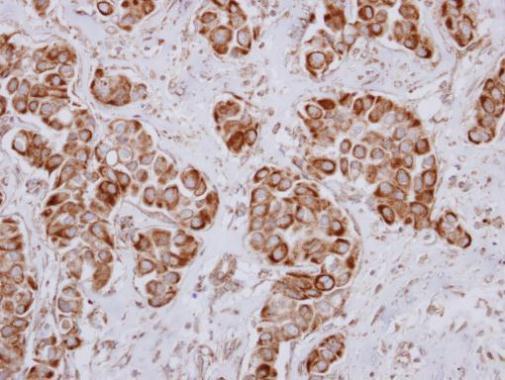
Immunohistochemical analysis of paraffin-embedded human breast cancer, using PKC nu antibody at 1:250 dilution.Application
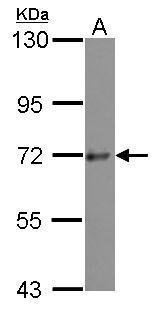
Sample (30 ug of whole cell lysate) A: 293T 7.5% SDS PAGE diluted at 1:1000| Product Name | PKC nu antibody |
|---|---|
| Antibody Type | Primary Antibodies |
| Product description | Rabbit Polyclonal antibody to PKC nu (protein kinase D3)Protein kinase C (PKC) is a family of serine- and threonine-specific protein kinases that can be activated by calcium and the second messenger diacylglycerol. PKC family members phosphorylate a wide variety of protein targets and are known to be involved in diverse cellular signaling pathways. PKC family members also serve as major receptors for phorbol esters, a class of tumor promoters. Each member of the PKC family has a specific expression profile and is believed to play a distinct role. The protein encoded by this gene is one of the PKC family members. This kinase can be activated rapidly by the agonists of G protein-coupled receptors. It resides in both cytoplasm and nucleus, and its nuclear accumulation is found to be dramatically enhanced in response to its activation. This kinase can also be activated after B-cell antigen receptor (BCR) engagement, which requires intact phopholipase C gamma and the involvement of other PKC family members. [provided by RefSeq] |
| Immunogen | Recombinant protein encompassing a sequence within the center region of human PKC nu. The exact sequence is proprietary. |
| Clonality | Polyclonal |
|---|---|
| Isotype | IgG |
| Host Species | Rabbit |
| Tested Applications | IHC-PWB |
| *Optimal dilutions/concentrations should be determined by the researcher. | |
| Species Reactivity | Human |
| Predicted Reactivity | Mouse, Rat, Rhesus Monkey, BovineMouse (97%), Rat (96%), Rhesus Monkey (99%), Bovine (97%) |
| Concentration | 1mg/ml |
| Purification | Affinity purified |
| Gene Synonyms | EPK2 antibody, PKC-NU antibody, PKD3 antibody, PRKCN antibody, nPKC-NU antibody, PRKD3 antibody, "protein kinase C, nu antibody", protein kinase EPK2 antibody, serine/threonine-protein kinase D3 antibody, protein kinase C nu type antibody, protein-serine/t |
|---|---|
| Molecular Weight(MW) | 100 kDa (note) (2) |
Application
Immunohistochemical analysis of paraffin-embedded human breast cancer, using PKC nu antibody at 1:250 dilution.
Application
Sample (30 ug of whole cell lysate) A: 293T 7.5% SDS PAGE diluted at 1:1000| Application Notes | *Optimal dilutions/concentrations should be determined by the researcher. |
|---|
| Form | Liquid |
|---|---|
| Storage Instructions | Keep as concentrated solution. Aliquot and store at -20ºC or below. Avoid multiple freeze-thaw cycles. |
| Storage Buffer | 0.1M Tris, 0.1M Glycine, 20% Glycerol (pH7). 0.01% Thimerosal was added as a preservative. |


