Application
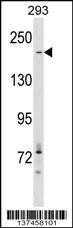
Western blot analysis in 293 cell line lysates (35ug/lane).| Product Name | ACACA Antibody |
|---|---|
| Antibody Type | Primary Antibodies |
| Antigen Alias | Acetyl-CoA carboxylase 1, ACC1, ACC-alpha, Biotin carboxylase, ACACA, ACAC, ACC1, ACCA |
| Product description | Acetyl-CoA carboxylase (ACC) is a complex multifunctional enzyme system. ACC is a biotin-containing enzyme which catalyzes the carboxylation of acetyl-CoA to malonyl-CoA, the rate-limiting step in fatty acid synthesis. There are two ACC forms, alpha and beta, encoded by two different genes. ACC-alpha is highly enriched in lipogenic tissues. The enzyme is under long term control at the transcriptional and translational levels and under short term regulation by the phosphorylation/dephosphorylation of targeted serine residues and by allosteric transformation by citrate or palmitoyl-CoA. Multiple alternatively spliced transcript variants divergent in the 5' sequence and encoding distinct isoforms have been found for this gene.1) Bailey, S.D., et al. Diabetes Care 33(10):2250-2253(2010) |
| Immunogen | This ACACA antibody is generated from rabbits immunized with a KLH conjugated synthetic peptide between 2010-2039 amino acids from the C-terminal region of human ACACA. |
| Clonality | Polyclonal |
|---|---|
| Isotype | Ig |
| Host Species | Rabbit |
| Tested Applications | WB |
| For WB starting dilution is: 1:1000: |
|
| Species Reactivity | Human |
| Concentration | 1mg/ml |
| Purification | Affinity purified |
| Gene Symbol | ACACA |
|---|---|
| Alternative Names | Acetyl-CoA carboxylase 1 ACC1 ACC-alpha Biotin carboxylase ACACA ACAC ACC1 ACCA |
| Molecular Weight(MW) | 266 kDa |
| Sequence Similarities | Predicted species reactivity based on immunogen sequence: Bovine |
Application
Western blot analysis in 293 cell line lysates (35ug/lane).| Application Notes | For WB starting dilution is: 1:1000: |
|---|
| Form | Liquid |
|---|---|
| Storage Instructions | Store at 4˚C for three months and -20˚C, stable for up to one year. As with all antibodies care should be taken to avoid repeated freeze thaw cycles. Antibodies should not be exposed to prolonged high temperatures. |
| Storage Buffer | Supplied in PBS with 0.09% (W/V) sodium azide. |


