Application
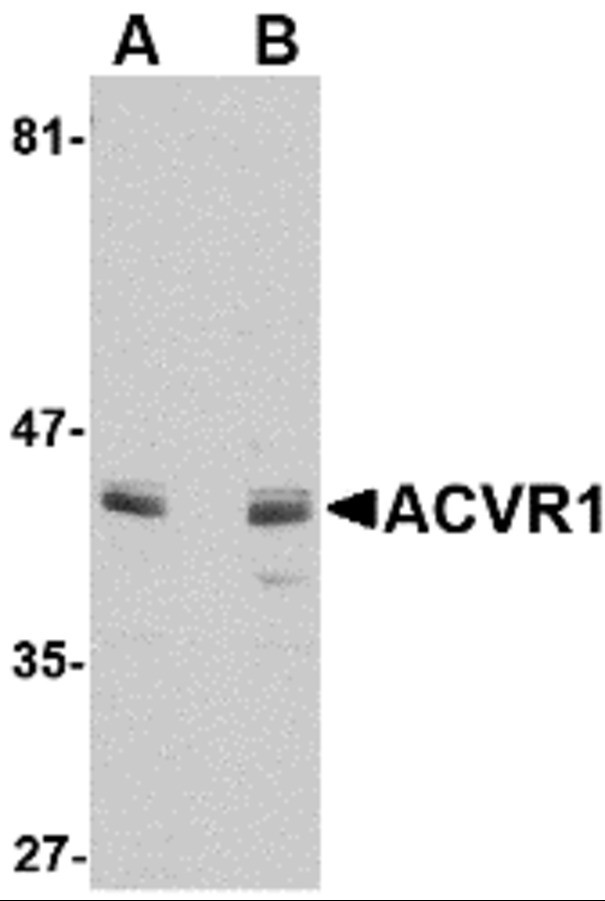
Western blot analysis of ACVR1 in A549 cell lysate with ACVR1 antibody at 1 μg/mL in (A) the absence and (B) the presence of blocking peptide.| Product Name | ACVR1 Antibody |
|---|---|
| Antibody Type | Primary Antibodies |
| Product description | ACVR1 Antibody: Activins are dimeric growth and differentiation factors which belong to the transforming growth factor-beta (TGF-beta) superfamily of structurally related signaling proteins. Activins signal through a heteromeric complex of receptor serine kinases which include at least two type I and two type II receptors. Unlike ACVR1B and ACVR1C, ACVR1, also known as activin receptor-like kinase 2 (ALK2), can not transduce activin-mediated signaling, but will transduce BMP and Mullerian inhibiting substance (MIS) group signaling. It is thought that ACVR1 also inhibits activin signaling by blocking the binding of activin to its type II receptor. Recent studies indicate that genetic variation in ACVR1 is associated with polycystic ovary syndrome, suggesting that ACVR1 signaling contributes to disturbed folliculogenesis in these patients.1) Tsuchida K, Sawchenko PN, Nishikawa S, et al. Molecular cloning of a novel type I receptor serine/threonine kinase for the TGF beta superfamily from rat brain. Mol. Cell. Neurosci.1996; 76:467-78. |
| Immunogen | ACVR1 antibody was raised against a 14 amino acid synthetic peptide near the amino terminus of the human ACVR1. The immunogen is located within the first 50 amino acids of ACVR1. |
| Clonality | Polyclonal |
|---|---|
| Isotype | IgG |
| Host Species | Rabbit |
| Tested Applications | ELISAWB |
| ACVR1 antibody can be used for detection of ACVR1 by Western blot at 1 μg/mL. | |
| Species Reactivity | HumanMouse |
| Concentration | 1mg/ml |
| Purification | Affinity purified |
| Gene Symbol | ACVR1 |
|---|---|
| Alternative Names | ACVR1 Antibody: FOP ALK2 SKR1 TSRI ACTRI ACVR1A ACVRLK2 Activin receptor type-1 Activin receptor type I ACTR-I |
| Sequence Similarities | Predicted species reactivity based on immunogen sequence: Bovine: (100%) |
| Tissue Specificity | At least four isoforms of ACVR1 are known to exist. This antibody is predicted to have no cross-reactivity to ACVR1B or ACVR1C. |
Application
Western blot analysis of ACVR1 in A549 cell lysate with ACVR1 antibody at 1 μg/mL in (A) the absence and (B) the presence of blocking peptide.| Application Notes | ACVR1 antibody can be used for detection of ACVR1 by Western blot at 1 μg/mL. |
|---|
| Form | Liquid |
|---|---|
| Storage Instructions | ACVR1 antibody can be stored at 4˚C for three months and -20˚C, stable for up to one year. As with all antibodies care should be taken to avoid repeated freeze thaw cycles. Antibodies should not be exposed to prolonged high temperatures. |
| Storage Buffer | ACVR1 Antibody is supplied in PBS containing 0.02% sodium azide. |


