Application
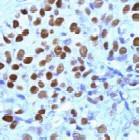
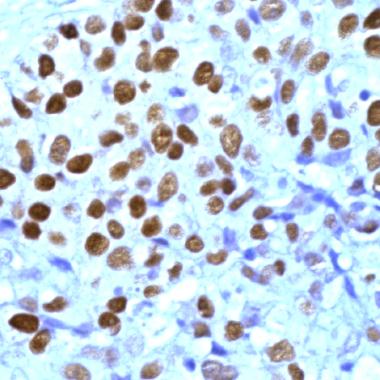
staining Progesterone Receptor in breast carcinoma by Immunohistochemistry (FFPE-sections).Application
Human Breast Carcinoma stained with anti-Progesterone Receptor (PR) antibody| Product Name | Progesterone Receptor antibody |
|---|---|
| Antibody Type | Primary Antibodies |
| Product description | Rabbit polyclonal to Progesterone ReceptorThe human Progesterone Receptor (PgR) is a member of the steroid family of nuclear receptors. PgR is found as a 120 kDa protein (Form B) or a 94 kDa protein (Form A) due to the use of alternative translation initiation sites. In its inactive state, PgR forms a multiprotein complex which includes heat shock proteins and immunophins. Upon binding of progesterone hormone to its receptor, there is a conformational change that allows dimerization and binding of the receptor to progesterone response elements (PRE) sequences, resulting in activated transcription. When bound to DNA, PgR can positively or negatively regulate gene transcription through the recruitment of coactivator (e.g. SRC 1) or corepressor (e.g. NCoR) proteins. |
| Immunogen | Synthetic peptide (unfortunately, the amino acid sequence is considered to be commercially sensitive) (Human) (C terminal). |
| Clonality | Polyclonal |
|---|---|
| Isotype | IgG |
| Host Species | Rabbit |
| Tested Applications | IHC-P |
| For IHC-P: Use at a dilution of 1:200 for 10 min at room temperature. Staining of formalin-fixed tissues requires boiling tissue sections in 10 mM citrate buffer, pH 6.0 for 10 min followed by cooling at room temperature for 20 min. Optimal dilutions/concentrations shlould be determined by the reseracher.: |
|
| Species Reactivity | Human |
| Concentration | 1mg/ml |
| Purification | Affinity purified |
| Gene Synonyms | PGR 607311 Progesterone receptor P06401 PR NR3C3 5241 |
|---|---|
| Target | Progesterone receptor |
| Cellular Localization | Nuclear |
Application
staining Progesterone Receptor in breast carcinoma by Immunohistochemistry (FFPE-sections).
Application
Human Breast Carcinoma stained with anti-Progesterone Receptor (PR) antibody| Positive Control | Breast Carcinomas |
|---|---|
| Application Notes | For IHC-P: Use at a dilution of 1:200 for 10 min at room temperature. Staining of formalin-fixed tissues requires boiling tissue sections in 10 mM citrate buffer, pH 6.0 for 10 min followed by cooling at room temperature for 20 min. Optimal dilutions/concentrations shlould be determined by the reseracher.: |
| Form | Liquid |
|---|---|
| Storage Instructions | Keep as concentrated solution, aliquot and store at 4°C. Do not freeze. |
| Storage Buffer | Phosphate-buffered saline, pH 7.4 containing 1% BSA and 0.09% sodium azide |


