Application
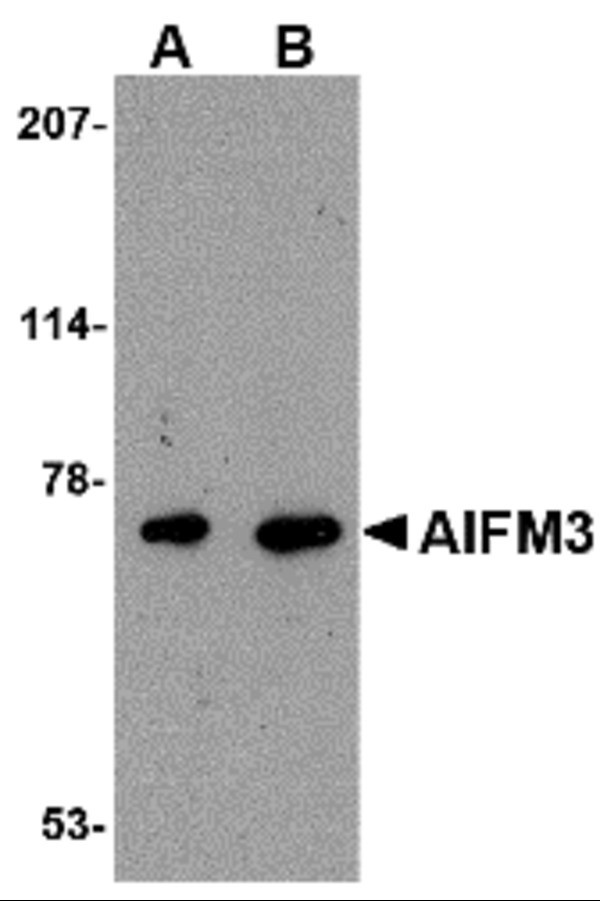
Western blot analysis of AIFM3 in human brain tissue lysate with AIFM3 antibody at (A) 1 and (B) 2 μg/mL.| Product Name | AIFM3 Antibody |
|---|---|
| Antibody Type | Primary Antibodies |
| Antigen Alias | AIFM3 Antibody: AIFL, AIFL, Apoptosis-inducing factor 3, Apoptosis-inducing factor-like protein |
| Product description | AIFM3 Antibody: Apoptosis, also known as programmed cell death, plays major roles in development and normal tissue turnover in addition to tumor formation. Recently a protein similar to the apoptosis-inducing factor (AIF) was cloned and designated AIFL (also known as AIFM3). AIFM3 is expressed ubiquitously and is predominantly localized to the inner membranes of mitochondria. Unlike AIF, AIFM3 does not translocate to the nucleus upon induction of apoptosis. However, overexpression of AIFM3, like AIF, induced cytochrome c release from the mitochondria, cleavage of caspase 3, and ultimately apoptosis, indicating AIFM3 induces apoptosis through caspase activation. Multiple isoforms of AIFM3 are known to exist.1) Jin Z and El Deiry WS. Overview of cell death signaling pathways. Cancer Biol. Ther.2004; 4:139-63 |
| Immunogen | AIFM3 antibody was raised against a 16 amino acid synthetic peptide from near the center of human AIFM3. The immunogen is located within amino acids 210 - 260 of AIFM3. |
| Clonality | Polyclonal |
|---|---|
| Isotype | IgG |
| Host Species | Rabbit |
| Tested Applications | ELISAWB |
| AIFM3 antibody can be used for the detection of AIFM3 by Western blot at 1 - 2 μg/mL.: |
|
| Species Reactivity | HumanMouseRat |
| Concentration | 1mg/ml |
| Purification | Affinity purified |
| Gene Symbol | AIFM3 |
|---|---|
| Alternative Names | AIFM3 Antibody: AIFL AIFL Apoptosis-inducing factor 3 Apoptosis-inducing factor-like protein |
Application
Western blot analysis of AIFM3 in human brain tissue lysate with AIFM3 antibody at (A) 1 and (B) 2 μg/mL.| Positive Control | 1) Cat. No. 1303 - Human Brain Tissue Lysate |
|---|---|
| Application Notes | AIFM3 antibody can be used for the detection of AIFM3 by Western blot at 1 - 2 μg/mL.: |
| Form | Liquid |
|---|---|
| Storage Instructions | AIFM3 antibody can be stored at 4˚C for three months and -20˚C, stable for up to one year. As with all antibodies care should be taken to avoid repeated freeze thaw cycles. Antibodies should not be exposed to prolonged high temperatures. |
| Storage Buffer | AIFM3 Antibody is supplied in PBS containing 0.02% sodium azide. |


