Application
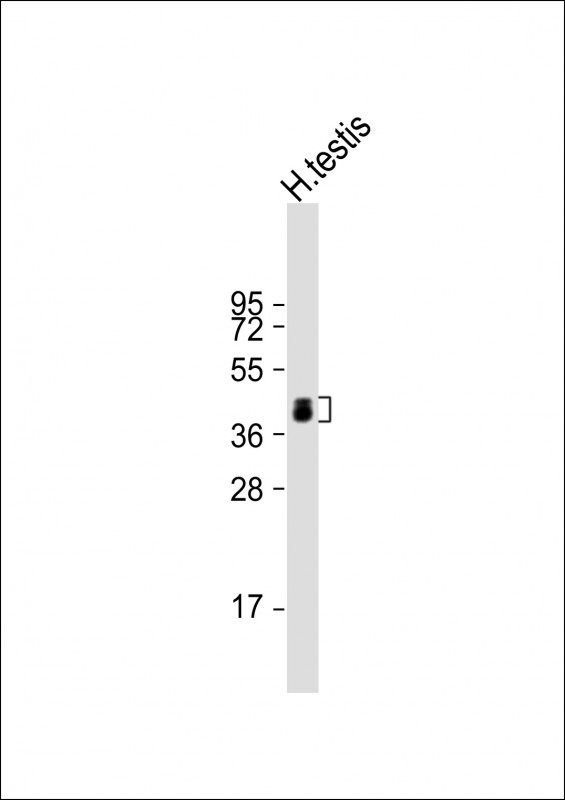
Western Blot at 1:4000 dilution + human testis lysate Lysates/proteins at 20 ug per lane.Application
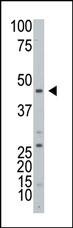
Western blot analysis of ART3 Antibody in HL60 cell line lysates (25ug/lane).| Product Name | ART3 Antibody |
|---|---|
| Antibody Type | Primary Antibodies |
| Antigen Alias | Ecto-ADP-ribosyltransferase 3, ADP-ribosyltransferase C2 and C3 toxin-like 3, ARTC3, Mono(ADP-ribosyl)transferase 3, NAD(P)(+)--arginine ADP-ribosyltransferase 3, ART3, TMART |
| Product description | Mono-ADP-ribosylation involves the transfer of the ADP-ribose moiety from NAD+ to a specific amino acid in the target protein. The rodent mono-ADP-ribosyltransferase RT6 is a glycosylphosphatidylinositol (GPI)-anchored membrane protein specifically expressed at the cell surface of rat and mouse T lymphocytes. The predicted 367-amino acid human ART3 protein has an estimated molecular mass of 41.5 kD and contains a hydrophobic peptide signal at its N terminus, 3 consensus motifs specific to enzymes catalyzing ADP-ribose transfer, a hydrophobic C-terminal sequence characteristic of a GPI-anchored protein, a novel motif repeated 3 times at its C terminus, and 1 potential glycosylation site.1 The ART3 and rodent RT6 proteins share 35% amino acid identity.1) Strausberg, R.L., et al., Proc. Natl. Acad. Sci. U.S.A. 99(26):16899-16903 (2002). |
| Immunogen | This ART3 antibody is generated from rabbits immunized with a KLH conjugated synthetic peptide between 280-310 amino acids from the C-terminal region of human ART3. |
| Clonality | Polyclonal |
|---|---|
| Isotype | Ig |
| Host Species | Rabbit |
| Tested Applications | WB |
| For WB starting dilution is: 1:1000: |
|
| Species Reactivity | Human |
| Concentration | 1mg/ml |
| Gene Symbol | ART3 |
|---|---|
| Alternative Names | Ecto-ADP-ribosyltransferase 3 ADP-ribosyltransferase C2 and C3 toxin-like 3 ARTC3 Mono(ADP-ribosyl)transferase 3 NAD(P)(+)--arginine ADP-ribosyltransferase 3 ART3 TMART |
| Molecular Weight(MW) | 44 kDa |
Application
Western Blot at 1:4000 dilution + human testis lysate Lysates/proteins at 20 ug per lane.
Application
Western blot analysis of ART3 Antibody in HL60 cell line lysates (25ug/lane).| Application Notes | For WB starting dilution is: 1:1000: |
|---|
| Form | Liquid |
|---|---|
| Storage Instructions | Store at 4˚C for three months and -20˚C, stable for up to one year. As with all antibodies care should be taken to avoid repeated freeze thaw cycles. Antibodies should not be exposed to prolonged high temperatures. |
| Storage Buffer | Supplied in PBS with 0.09% (W/V) sodium azide. |


