Application
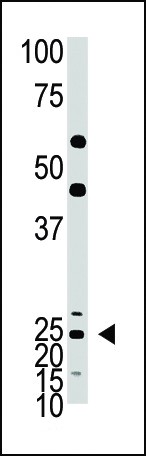
Antibody is used in Western blot to detect Hash1 in mouse lung tissue lysate.| Product Name | ASCL1 Antibody |
|---|---|
| Antibody Type | Primary Antibodies |
| Antigen Alias | Achaete-scute homolog 1, ASH-1, hASH1, Class A basic helix-loop-helix protein 46, bHLHa46, ASCL1, ASH1, BHLHA46, HASH1 |
| Product description | ACSL1, alternatively titled Hash1 or Mash1, is a member of the basic helix-loop-helix (BHLH) family of transcription factors. It activates transcription by binding to the E box (5'-CANNTG-3'). Dimerization with other BHLH proteins is required for efficient DNA binding. ACSL1 plays a role in the neuronal commitment and differentiation and in the generation of olfactory and autonomic neurons. The protein is highly expressed in medullary thyroid cancer and small cell lung cancer and may be a useful marker for these cancers. The presence of a CAG repeat in the gene suggests it may also play a role in tumor formation.1) Sriuranpong, V., et al., Mol. Cell. Biol. 22(9):3129-3139 (2002). Westerman, B.A., et al., Clin. Cancer Res. 8(4):1082-1086 (2002). Chen, H., et al., Cell Growth Differ. 8(6):677-686 (1997). Borges, M., et al., Nature 386(6627):852-855 (1997). Renault, B., et al., Genomics 30(1):81-83 (1995). |
| Immunogen | This ASCL1 (Achaete-scute homolog 1) antibody is generated from rabbits immunized with a KLH conjugated synthetic peptide between 166-196 amino acids from the C-terminal region of human ASCL1 (Achaete-scute homolog 1). |
| Clonality | Polyclonal |
|---|---|
| Isotype | Ig |
| Host Species | Rabbit |
| Tested Applications | WB |
| For WB starting dilution is: 1:1000: |
|
| Species Reactivity | HumanMouse |
| Concentration | 1mg/ml |
| Gene Symbol | ASCL1 |
|---|---|
| Alternative Names | Achaete-scute homolog 1 ASH-1 hASH1 Class A basic helix-loop-helix protein 46 bHLHa46 ASCL1 ASH1 BHLHA46 HASH1 |
| Molecular Weight(MW) | 25 kDa |
| Sequence Similarities | Predicted species reactivity based on immunogen sequence: Rat |
Application
Antibody is used in Western blot to detect Hash1 in mouse lung tissue lysate.| Application Notes | For WB starting dilution is: 1:1000: |
|---|
| Form | Liquid |
|---|---|
| Storage Instructions | Store at 4˚C for three months and -20˚C, stable for up to one year. As with all antibodies care should be taken to avoid repeated freeze thaw cycles. Antibodies should not be exposed to prolonged high temperatures. |
| Storage Buffer | Supplied in PBS with 0.09% (W/V) sodium azide. |


