Application
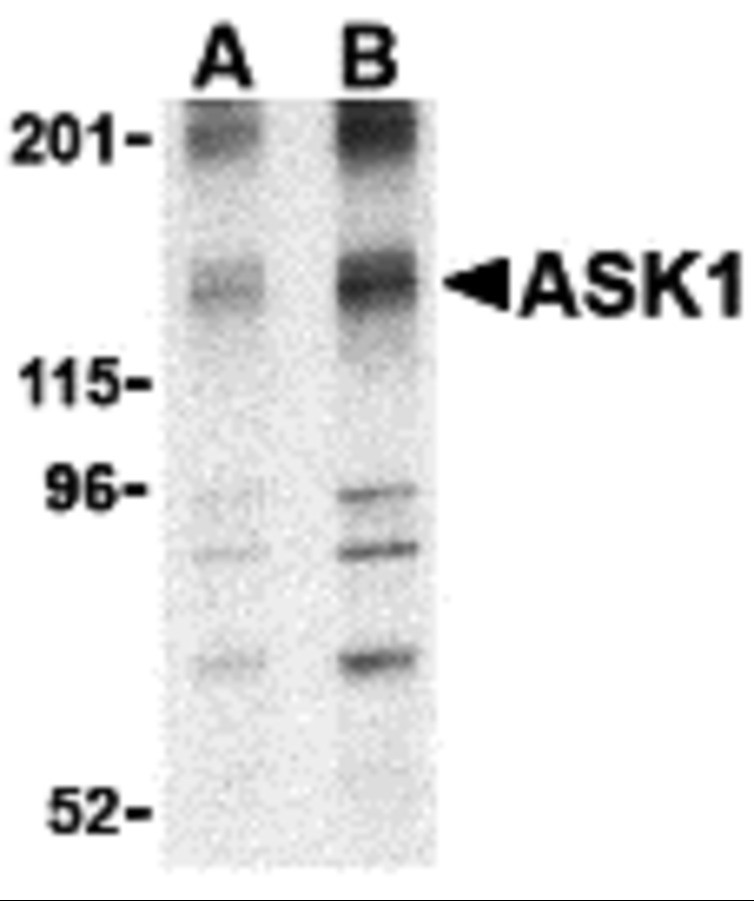
Western blot analysis of ASK1 in 3T3 cell lysate with ASK1 antibody at (A) 1 and (B) 2 μg/mL.| Product Name | ASK1 Antibody |
|---|---|
| Antibody Type | Primary Antibodies |
| Antigen Alias | ASK1 Antibody: ASK1, MEKK5, MAPKKK5, ASK1, Mitogen-activated protein kinase kinase kinase 5, Apoptosis signal-regulating kinase 1, ASK-1 |
| Product description | ASK1 Antibody: Mitogen-activated protein (MAP) kinase cascades are activated in response to various extracellular stimuli, including cytokines, growth factors and environmental stresses. A novel MAP kinase kinase kinase (MAPKKK) was recently identified and designated ASK1 (for apoptosis signal-regulating kinase 1) and MAPKKK5. ASK1 activated two different subgroups of MAPKK, MKK4 and MKK6, which in turn activated c-Jun N-terminal kinase (JNK) and p38 MAP kinase, respectively. ASK1/MAPKKK5 is activated by TNFR and Fas through the interaction with members of the TRAF family and Fas-associated protein Daxx. Overexpression of ASK1 induced apoptotic cell death, and a catalytically inactive form of ASK1 inhibited TNF-α-induced apoptosis. ASK1 is expressed in variety of tissues and cell lines.1) Ichijo H, Nishida E, Irie K, et al. Induction of apoptosis by ASK1, a mammalian MAPKKK that activates SAPK/JNK and p38 signaling pathways. Science1997; 275:90-4. |
| Immunogen | ASK1 antibody was raised against a 16 amino acid synthetic peptide from near the amino terminus of human ASK1. The immunogen is located within amino acids 390 - 440 of ASK1. |
| Clonality | Polyclonal |
|---|---|
| Isotype | IgG |
| Host Species | Rabbit |
| Tested Applications | ELISAWB |
| ASK1 antibody can be used for the detection of ASK1 by Western blot at 1 - 2 μg/mL. 3: |
|
| Species Reactivity | HumanMouse |
| Concentration | 1mg/ml |
| Purification | Affinity purified |
| Gene Symbol | MAP3K5 |
|---|---|
| Alternative Names | ASK1 Antibody: ASK1 MEKK5 MAPKKK5 ASK1 Mitogen-activated protein kinase kinase kinase 5 Apoptosis signal-regulating kinase 1 ASK-1 |
Application
Western blot analysis of ASK1 in 3T3 cell lysate with ASK1 antibody at (A) 1 and (B) 2 μg/mL.| Positive Control | 1) Cat. No. 1212 - 3T3 Cell Lysate |
|---|---|
| Application Notes | ASK1 antibody can be used for the detection of ASK1 by Western blot at 1 - 2 μg/mL. 3: |
| Form | Liquid |
|---|---|
| Storage Instructions | ASK1 antibody can be stored at 4˚C for three months and -20˚C, stable for up to one year. As with all antibodies care should be taken to avoid repeated freeze thaw cycles. Antibodies should not be exposed to prolonged high temperatures. |
| Storage Buffer | ASK1 Antibody is supplied in PBS containing 0.02% sodium azide. |


