Application
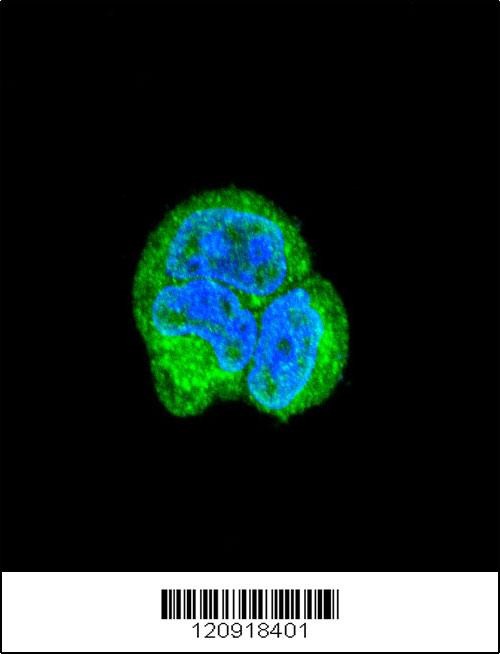
Confocal immunofluorescent analysis of ASPA Antibody (N-term)with MCF-7 cell followed by Alexa Fluor 488-conjugated goat anti-rabbit lgG (green). DAPI was used to stain the cell nuclear (blue).| Product Name | ASPA Antibody |
|---|---|
| Antibody Type | Primary Antibodies |
| Antigen Alias | Aspartoacylase, Aminoacylase-2, ACY-2, ASPA, ACY2, ASP |
| Product description | ASPA is an enzyme that catalyzes the conversion of N-acetyl_L-aspartic acid (NAA) to aspartate and acetate. NAA is abundant in the brain where hydrolysis by aspartoacylase is thought to help maintain white matter. This protein is an NAA scavenger in other tissues.1) Bitto,E., et.al., Proc. Natl. Acad. Sci. U.S.A. 104 (2), 456-461 (2007) |
| Immunogen | This ASPA antibody is generated from rabbits immunized with a KLH conjugated synthetic peptide between 82-110 amino acids from the N-terminal region of human ASPA. |
| Clonality | Polyclonal |
|---|---|
| Isotype | Ig |
| Host Species | Rabbit |
| Tested Applications | FACSIFIHC-PWB |
| For WB starting dilution is: 1:1000 For IHC-P starting dilution is: 1:50~100 For FACS starting dilution is: 1:10~50 For IF starting dilution is: 1:10~50: |
|
| Species Reactivity | Human |
| Concentration | 1mg/ml |
| Gene Symbol | ASPA |
|---|---|
| Alternative Names | Aspartoacylase Aminoacylase-2 ACY-2 ASPA ACY2 ASP |
| Molecular Weight(MW) | 36 kDa |
| Sequence Similarities | Predicted species reactivity based on immunogen sequence: Bovine |
Application
Confocal immunofluorescent analysis of ASPA Antibody (N-term)with MCF-7 cell followed by Alexa Fluor 488-conjugated goat anti-rabbit lgG (green). DAPI was used to stain the cell nuclear (blue).| Application Notes | For WB starting dilution is: 1:1000 For IHC-P starting dilution is: 1:50~100 For FACS starting dilution is: 1:10~50 For IF starting dilution is: 1:10~50: |
|---|
| Form | Liquid |
|---|---|
| Storage Instructions | Store at 4˚C for three months and -20˚C, stable for up to one year. As with all antibodies care should be taken to avoid repeated freeze thaw cycles. Antibodies should not be exposed to prolonged high temperatures. |
| Storage Buffer | Supplied in PBS with 0.09% (W/V) sodium azide. |


