Application
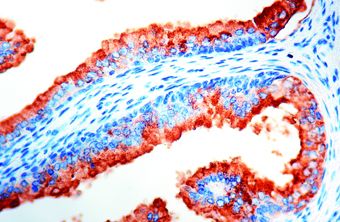
Formalin fixed paraffin embedded human prostate stained with PSA antibody (cat. # ).Application
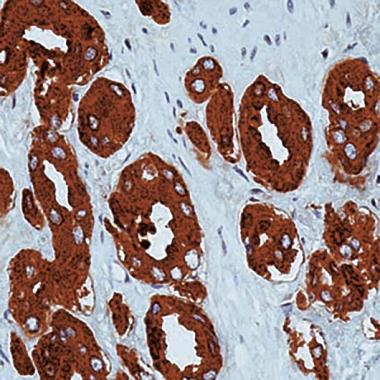
IHC-P analysis of prostate carcinoma using PSA antibody.| Product Name | PSA antibody |
|---|---|
| Antibody Type | Primary Antibodies |
| Product description | Rabbit polyclonal to PSAKallikreins are a subgroup of serine proteases having diverse physiological functions. Growing evidence suggests that many kallikreins are implicated in carcinogenesis and some have potential as novel cancer and other disease biomarkers. This gene is one of the fifteen kallikrein subfamily members located in a cluster on chromosome 19. Its protein product is a protease present in seminal plasma. It is thought to function normally in the liquefaction of seminal coagulum, presumably by hydrolysis of the high molecular mass seminal vesicle protein. Serum level of this protein, called PSA in the clinical setting, is useful in the diagnosis and monitoring of prostatic carcinoma. Alternate splicing of this gene generates two transcript variants encoding different isoforms. Additional transcript variants have been described, but it is unclear if these transcripts are normally expressed or if they are specific to benign or malignant tumors. |
| Immunogen | Prostate specific antigen isolated from human seminal plasma. |
| Clonality | Polyclonal |
|---|---|
| Isotype | IgG |
| Host Species | Rabbit |
| Tested Applications | IHC-FIHC-P |
| This antibody may be diluted to a titer of 1:50-1:150 in an ABC method. We suggest an incubation period of 30-60 minutes at room temperature. However, depending upon the fixation conditions and the staining system employed, optimal incubation and dilutions should be determined by the user.: |
|
| Species Reactivity | Human |
| Concentration | 1mg/ml |
| Purification | Protein A |
| Gene Synonyms | P07288 APS hK3 354 PSA 176820 KLK2A1 KLK3 |
|---|---|
| Target | PSA |
| Tissue Specificity | This antibody reacts with PSA. Staining was observed in the prostatic ductal epithelium of normal and neoplastic prostate.No staining with any other cell type has been observed. |
Application
Formalin fixed paraffin embedded human prostate stained with PSA antibody (cat. # ).
Application
IHC-P analysis of prostate carcinoma using PSA antibody.| Application Notes | This antibody may be diluted to a titer of 1:50-1:150 in an ABC method. We suggest an incubation period of 30-60 minutes at room temperature. However, depending upon the fixation conditions and the staining system employed, optimal incubation and dilutions should be determined by the user.: |
|---|
| Form | Liquid |
|---|---|
| Storage Instructions | Keep as concentrated solution, aliquot and store at 4°C. |
| Storage Buffer | This antibody contains sodium azide. |


