Application
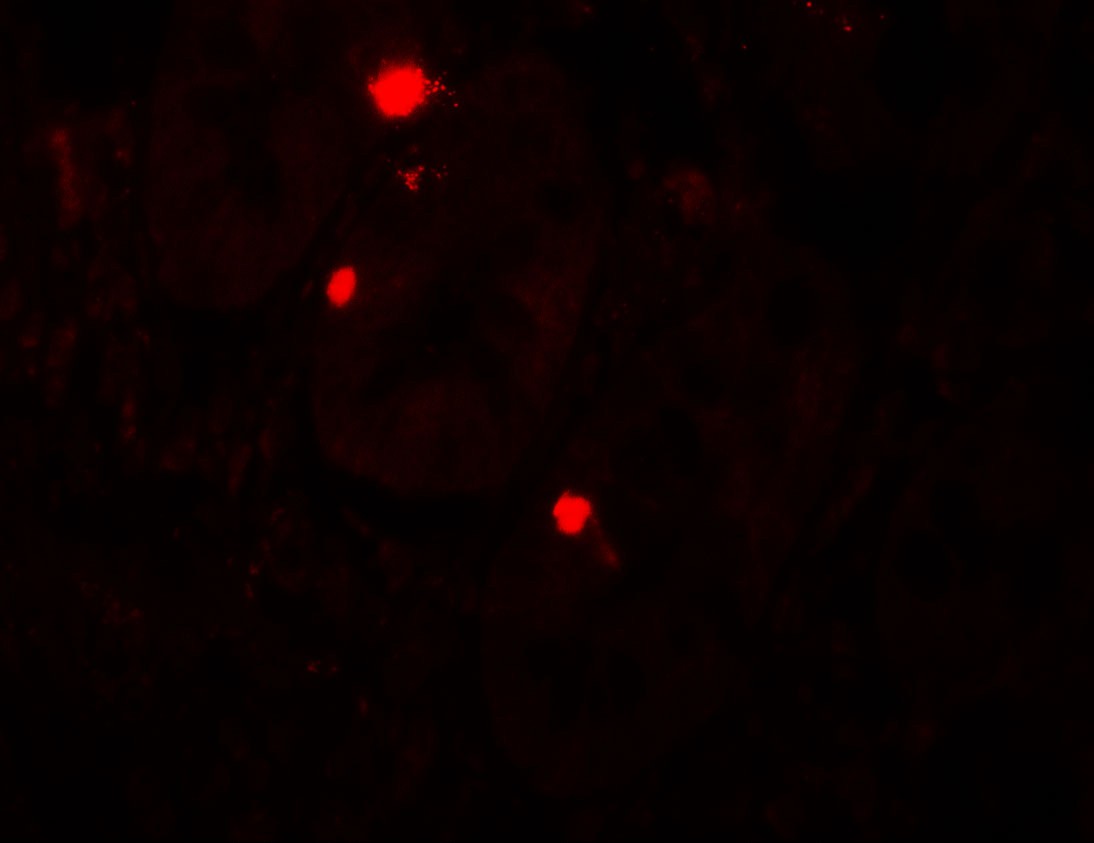
Immunofluorescence of ATG14 in human small intestine tissue with ATG14 antibody at 10 μg/mL.Application
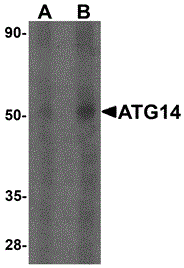
Western blot analysis of ATG14 in human small intestine tissue lysate with ATG14 antibody at (A) 1 and (B) 2 μg/mL.| Product Name | ATG14 Antibody |
|---|---|
| Antibody Type | Primary Antibodies |
| Antigen Alias | ATG14 Antibody: ATG14L, BARKOR, KIAA0831, Beclin 1-associated autophagy-related key regulator, Autophagy-related protein 14-like protein, Barkor |
| Product description | ATG14 Antibody: Autophagy, the process of bulk degradation of cellular proteins through an autophagosomic-lysosomal pathway is important for normal growth control and may be defective in tumor cells. It is involved in the preservation of cellular nutrients under starvation conditions as well as the normal turnover of cytosolic components. This process is negatively regulated by TOR (Target of rapamycin) through phosphorylation of autophagy protein ATG1. ATG14 is a subunit of a class III phosphatidylinositol (PtdIns) 3-kinase complex that targets the complex to the endoplasmic reticulum, the site of autophagosome formation.1) Gozuacik D and Kimchi A. Autophagy as a cell death and tumor suppressor mechanism. Oncogene 2004; 23:2891-906. |
| Immunogen | ATG14 antibody was raised against an 18 amino acid synthetic peptide near the center of human ATG14. The immunogen is located within amino acids 270 - 320 of ATG14. |
| Modification | Acetylated |
| Clonality | Polyclonal |
|---|---|
| Isotype | IgG |
| Host Species | Rabbit |
| Tested Applications | ELISAIFWB |
| WB:1:500~1:2000 IF:1:100~1:500 |
|
| Species Reactivity | HumanMouseRat |
| Concentration | 1mg/ml |
| Purification | Affinity purified |
| Gene Symbol | ATG14 |
|---|---|
| Alternative Names | ATG14 Antibody: ATG14L BARKOR KIAA0831 Beclin 1-associated autophagy-related key regulator Autophagy-related protein 14-like protein Barkor |
| Molecular Weight(MW) | 54 kDa |
| Sequence Similarities | 2) Cat. No. 11-801 - Human Small Intestine Tissue Slide |
| Tissue Specificity | At least three isoforms of ATG14 are known to exist; this antibody will detect all three isoforms |
Application
Immunofluorescence of ATG14 in human small intestine tissue with ATG14 antibody at 10 μg/mL.
Application
Western blot analysis of ATG14 in human small intestine tissue lysate with ATG14 antibody at (A) 1 and (B) 2 μg/mL.| Positive Control | 1) Cat. No. 1308 - Human Small Intestine Tissue Lysate |
|---|---|
| Application Notes | WB:1:500~1:2000 IF:1:100~1:500 |
| Form | Liquid |
|---|---|
| Storage Instructions | ATG14 antibody can be stored at 4˚C for three months and -20˚C, stable for up to one year. As with all antibodies care should be taken to avoid repeated freeze thaw cycles. Antibodies should not be exposed to prolonged high temperatures. |
| Storage Buffer | ATG14 Antibody is supplied in PBS containing 0.02% sodium azide. |


