Application
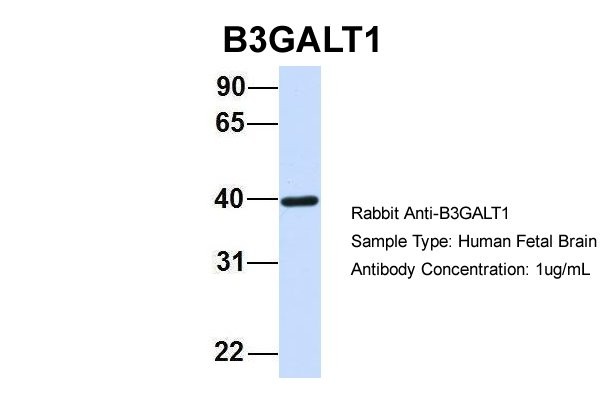
Antibody used in WB on Hum. Fetal Brain at 1 ug/ml.Application
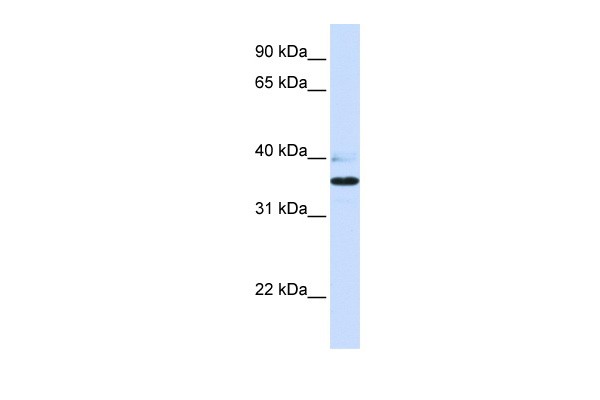
Antibody used in WB on Human Heart at 0.2-1 ug/ml.| Product Name | B3GALT1 Antibody |
|---|---|
| Antibody Type | Primary Antibodies |
| Antigen Alias | B3GALT1, MGC126594, beta3Gal-T1 |
| Product description | B3GALT1 is a member of the beta-1,3-galactosyltransferase (beta3GalT) family. This family are type II membrane-bound glycoproteins with diverse enzymatic functions using different donor substrates (UDP-galactose and UDP-N-acetylglucosamine) and different acceptor sugars (N-acetylglucosamine, galactose, N-acetylgalactosamine). The beta3GalT genes are distantly related to the Drosophila Brainiac gene and have the protein coding sequence contained in a single exon. The beta3GalT proteins also contain conserved sequences not found in the beta4GalT or alpha3GalT proteins. The carbohydrate chains synthesized by these enzymes are designated as type 1, whereas beta4GalT enzymes synthesize type 2 carbohydrate chains. The ratio of type 1:type 2 chains changes during embryogenesis. By sequence similarity, the beta3GalT genes fall into at least two groups: beta3GalT4 and 4 other beta3GalT genes (beta3GalT1-3, beta3GalT5). This gene is expressed exclusively in the brain. The encoded protein shows strict donor substrate specificity for UDP-galactose.This gene is a member of the beta-1,3-galactosyltransferase (beta3GalT) gene family. This family encodes type II membrane-bound glycoproteins with diverse enzymatic functions using different donor substrates (UDP-galactose and UDP-N-acetylglucosamine) and different acceptor sugars (N-acetylglucosamine, galactose, N-acetylgalactosamine). The beta3GalT genes are distantly related to the Drosophila Brainiac gene and have the protein coding sequence contained in a single exon. The beta3GalT proteins also contain conserved sequences not found in the beta4GalT or alpha3GalT proteins. The carbohydrate chains synthesized by these enzymes are designated as type 1, whereas beta4GalT enzymes synthesize type 2 carbohydrate chains. The ratio of type 1:type 2 chains changes during embryogenesis. By sequence similarity, the beta3GalT genes fall into at least two groups: beta3GalT4 and 4 other beta3GalT genes (beta3GalT1-3, beta3GalT5). This gene is expressed exclusively in the brain. The encoded protein shows strict donor substrate specificity for UDP-galactose.1) Hillier, L.W., (2005) Nature 434 (7034), 724-731. |
| Immunogen | Antibody produced in rabbits immunized with a synthetic peptide corresponding a region of human B3GALT1. |
| Clonality | Polyclonal |
|---|---|
| Host Species | Rabbit |
| Tested Applications | ELISAWB |
| B3GALT1 antibody can be used for detection of B3GALT1 by ELISA at 1:312500. B3GALT1 antibody can be used for detection of B3GALT1 by western blot at 1 μg/mL, and HRP conjugated secondary antibody should be diluted 1:50,000 - 100,000.: |
|
| Species Reactivity | HumanMouseRat |
| Concentration | 1mg/ml |
| Purification | Affinity purified |
| Gene Symbol | B3GALT1 |
|---|---|
| Alternative Names | B3GALT1 MGC126594 beta3Gal-T1 |
| Molecular Weight(MW) | 38 kDa |
Application
Antibody used in WB on Hum. Fetal Brain at 1 ug/ml.
Application
Antibody used in WB on Human Heart at 0.2-1 ug/ml.| Positive Control | 1) Cat. No. XBL-10407 - Fetal Heart Tissue Lysate |
|---|---|
| Application Notes | B3GALT1 antibody can be used for detection of B3GALT1 by ELISA at 1:312500. B3GALT1 antibody can be used for detection of B3GALT1 by western blot at 1 μg/mL, and HRP conjugated secondary antibody should be diluted 1:50,000 - 100,000.: |
| Form | Liquid |
|---|---|
| Storage Instructions | For short periods of storage (days) store at 4˚C. For longer periods of storage, store B3GALT1 antibody at -20˚C. As with any antibody avoid repeat freeze-thaw cycles. |
| Storage Buffer | Antibody is lyophilized in PBS buffer with 2% sucrose. Add 50 μL of distilled water. Final antibody concentration is 1 mg/mL. |


