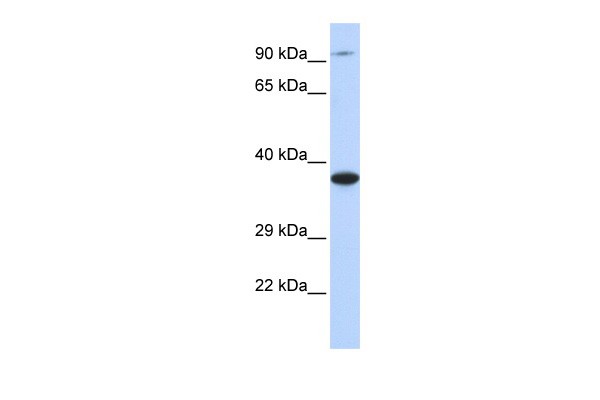
Application
Antibody used in WB on Human 293T at 0.2-1 ug/ml.| Product Name | BBS5 Antibody |
|---|---|
| Antibody Type | Primary Antibodies |
| Product description | BBS5 is a protein that has been directly linked to Bardet-Biedl syndrome. The primary features of this syndrome include retinal dystrophy, obesity, polydactyly, renal abnormalities and learning disabilities. Experimentation in non-human eukaryotes suggests that this gene is expressed in ciliated cells and that it is required for the formation of cilia.This gene encodes a protein that has been directly linked to Bardet-Biedl syndrome. The primary features of this syndrome include retinal dystrophy, obesity, polydactyly, renal abnormalities and learning disabilities. Experimentation in non-human eukaryotes suggests that this gene is expressed in ciliated cells and that it is required for the formation of cilia. Alternate transcriptional splice variants have been observed but have not been fully characterized.1) Hjortshoj, T.D., (2008) Am. J. Med. Genet. A 146A (4), 517-520. |
| Immunogen | Antibody produced in rabbits immunized with a synthetic peptide corresponding a region of human BBS5. |
| Clonality | Polyclonal |
|---|---|
| Host Species | Rabbit |
| Tested Applications | ELISAWB |
| BBS5 antibody can be used for detection of BBS5 by ELISA at 1:312500. BBS5 antibody can be used for detection of BBS5 by western blot at 1 μg/mL, and HRP conjugated secondary antibody should be diluted 1:50,000 - 100,000. | |
| Species Reactivity | HumanMouseRat |
| Concentration | 1mg/ml |
| Purification | Affinity purified |
| Gene Symbol | BBS5 |
|---|---|
| Alternative Names | BBS5 |
| Molecular Weight(MW) | 39 kDa |
Application
Antibody used in WB on Human 293T at 0.2-1 ug/ml.| Positive Control | 1) 293T Cell Lysate |
|---|---|
| Application Notes | BBS5 antibody can be used for detection of BBS5 by ELISA at 1:312500. BBS5 antibody can be used for detection of BBS5 by western blot at 1 μg/mL, and HRP conjugated secondary antibody should be diluted 1:50,000 - 100,000. |
| Form | Liquid |
|---|---|
| Storage Instructions | For short periods of storage (days) store at 4˚C. For longer periods of storage, store BBS5 antibody at -20˚C. As with any antibody avoid repeat freeze-thaw cycles. |
| Storage Buffer | Antibody is lyophilized in PBS buffer with 2% sucrose. Add 50 μL of distilled water. Final antibody concentration is 1 mg/mL. |


