Application
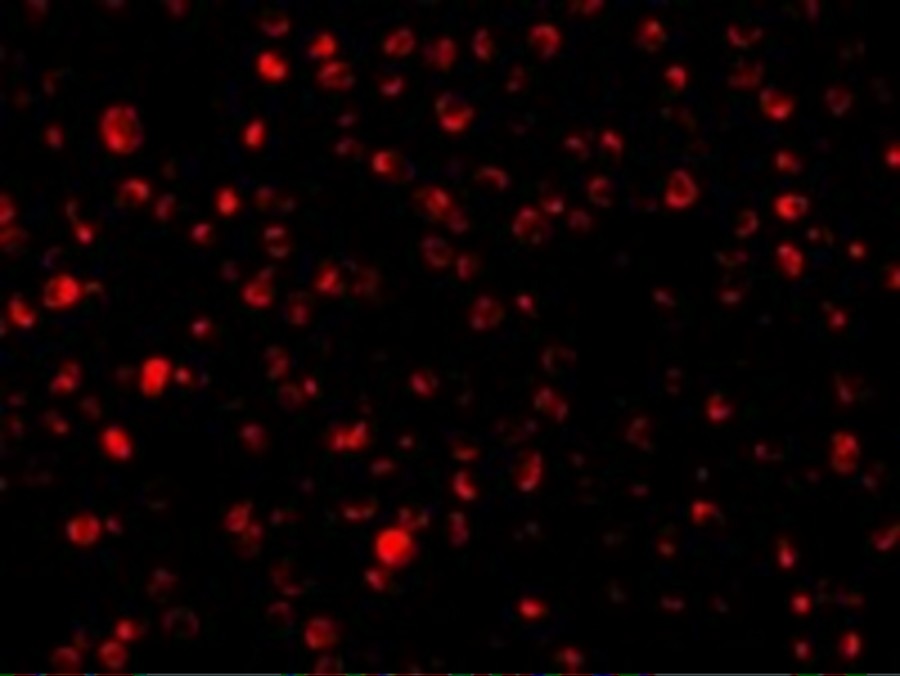
Immunofluorescence of Bit1 in 3T3 cells with Bit1 antibody at 20 μg/mL.| Product Name | Bit1 Antibody |
|---|---|
| Antibody Type | Primary Antibodies |
| Product description | Bit1 Antibody: Adhesion to extracellular matrix regulates cell survival through both integrin engagement and appropriate cell spreading. Anoikis is the molecular mechanism of apoptosis induced by integrin detachment. Bit1 (Bcl-2 inhibitor of transcription 1) was recently identified as being involved in this process. Bit1 is a mitochondrial protein that is released into the cytoplasm upon onset of apoptosis where it forms a complex with AES, a small Groucho/transducin-like enhancer of split (TLE) protein and induces caspase-independent apoptosis. Both AES and TLE proteins are transcriptional co-repressors that play important roles in neurogenesis, segmentation, and sex determination. It has been suggested that Bit1-AES complexes turn off a survival-promoting gene transcription program controlled by TLE. Interestingly, apoptosis of cells transfected with Bit1 and AES could be inhibited if the cells were allowed to attach to fibronectin through the alpha5beta1 integrin suggesting that the Bit1-AES pathway contributing to anoikis is regulated by integrins, and in particular, the alpha5beta1 integrin.1) Martin SS and Vuori K. Regulation of Bcl-2 proteins during anoikis and amorphosis. Biochim Biophys Acta. 2004; 1692:145-57. |
| Immunogen | Bit1 antibody was raised against a 15 amino acid synthetic peptide from near the amino-terminus of human Bit1. The immunogen is located within amino acids 20 - 70 of Bit1. |
| Clonality | Polyclonal |
|---|---|
| Isotype | IgG |
| Host Species | Rabbit |
| Tested Applications | ICCIF |
| Bit1 antibody can be used for the detection of Bit1 by Western blot at 1 - 4 μg/mL. Antibody can also be used for immunocytochemistry starting at 2 μg/mL. For immunofluorescence start at 20 μg/mL. | |
| Species Reactivity | Rat |
| Concentration | 1mg/ml |
| Purification | Affinity purified |
| Gene Symbol | PTRH2 |
|---|---|
| Alternative Names | Bit1 Antibody: BIT1 PTH2 CGI-147 BIT1 Peptidyl-tRNA hydrolase 2 mitochondrial Bcl-2 inhibitor of transcription 1 PTH 2 |
| Sequence Similarities | 3) Cat. No. 17-201 - 3T3/BALB Cell Slide |
Application
Immunofluorescence of Bit1 in 3T3 cells with Bit1 antibody at 20 μg/mL.| Positive Control | 1) Cat. No. 1288 - A20 Cell Lysate |
|---|---|
| Application Notes | Bit1 antibody can be used for the detection of Bit1 by Western blot at 1 - 4 μg/mL. Antibody can also be used for immunocytochemistry starting at 2 μg/mL. For immunofluorescence start at 20 μg/mL. |
| Form | Liquid |
|---|---|
| Storage Instructions | Bit1 antibody can be stored at 4˚C for three months and -20˚C, stable for up to one year. As with all antibodies care should be taken to avoid repeated freeze thaw cycles. Antibodies should not be exposed to prolonged high temperatures. |
| Storage Buffer | Bit1 Antibody is supplied in PBS containing 0.02% sodium azide. |


