Application
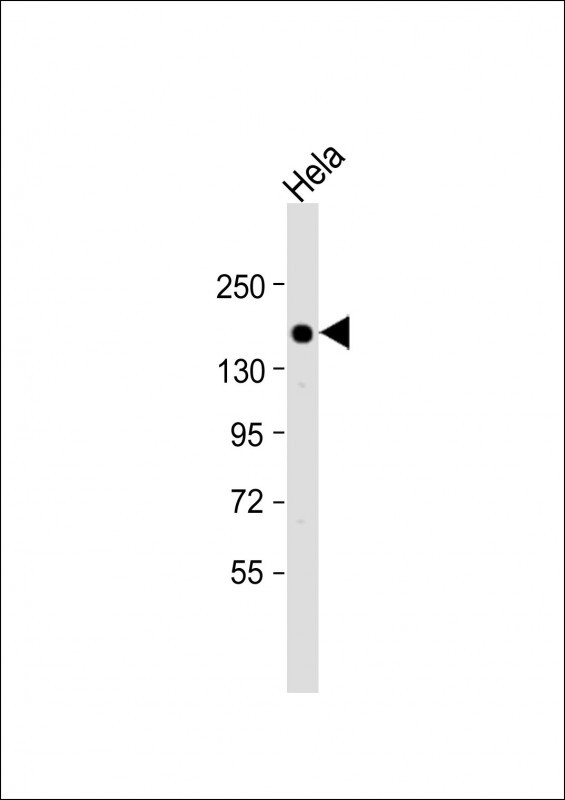
Western Blot at 1:1000 dilution + Hela whole cell lysate Lysates/proteins at 20 ug per lane.| Product Name | BRCA1 Antibody |
|---|---|
| Antibody Type | Primary Antibodies |
| Antigen Alias | Breast cancer type 1 susceptibility protein, 632-, RING finger protein 53, BRCA1, RNF53 |
| Product description | This gene encodes a nuclear phosphoprotein that plays a role in maintaining genomic stability, and it also acts as a tumor suppressor. The encoded protein combines with other tumor suppressors, DNA damage sensors, and signal transducers to form a large multi-subunit protein complex known as the BRCA1-associated genome surveillance complex (BASC). This gene product associates with RNA polymerase II, and through the C-terminal domain, also interacts with histone deacetylase complexes. This protein thus plays a role in transcription, DNA repair of double-stranded breaks, and recombination. Mutations in this gene are responsible for approximately 40% of inherited breast cancers and more than 80% of inherited breast and ovarian cancers. Alternative splicing plays a role in modulating the subcellular localization and physiological function of this gene. Many alternatively spliced transcript variants, some of which are disease-associated mutations, have been described for this gene, but the full-length natures of only some of these variants has been described. A related pseudogene, which is also located on chromosome 17, has been identified. [provided by RefSeq].1) Matsuoka, S., et al. Science 316(5828):1160-1166(2007) |
| Immunogen | This BRCA1 antibody is generated from rabbits immunized with a KLH conjugated synthetic peptide between 443-472 amino acids from the N-terminal region of human BRCA1. |
| Clonality | Polyclonal |
|---|---|
| Isotype | Ig |
| Host Species | Rabbit |
| Tested Applications | WB |
| For WB starting dilution is: 1:1000: |
|
| Species Reactivity | Human |
| Concentration | 1mg/ml |
| Purification | Affinity purified |
| Gene Symbol | BRCA1 |
|---|---|
| Alternative Names | Breast cancer type 1 susceptibility protein 632- RING finger protein 53 BRCA1 RNF53 |
| Molecular Weight(MW) | 208 kDa |
Application
Western Blot at 1:1000 dilution + Hela whole cell lysate Lysates/proteins at 20 ug per lane.| Application Notes | For WB starting dilution is: 1:1000: |
|---|
| Form | Liquid |
|---|---|
| Storage Instructions | Store at 4˚C for three months and -20˚C, stable for up to one year. As with all antibodies care should be taken to avoid repeated freeze thaw cycles. Antibodies should not be exposed to prolonged high temperatures. |
| Storage Buffer | Supplied in PBS with 0.09% (W/V) sodium azide. |


