Application
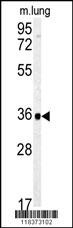
Western blot analysis of CA4 Antibody in mouse lung tissue lysates (35ug/lane)| Product Name | CA4 Antibody |
|---|---|
| Antibody Type | Primary Antibodies |
| Product description | CA4 is a large family of zinc metalloenzymes that catalyze the reversible hydration of carbon dioxide. They participate in a variety of biological processes, including respiration, calcification, acid-base balance, bone resorption, and the formation of aqueous humor, cerebrospinal fluid, saliva, and gastric acid. They show extensive diversity in tissue distribution and in their subcellular localization. This protein is a glycosylphosphatidyl-inositol-anchored membrane isozyme expressed on the luminal surfaces of pulmonary (and certain other) capillaries and proximal renal tubules. Its exact function is not known; however, the protein may have a role in inherited renal abnormalities of bicarbonate transport.1) Okuyama T., Sato S.Proc. Natl. Acad. Sci. U.S.A. 89:1315-1319(1992) Okuyama T.Genomics 16:678-684(1993) Yang Z., Alvarez B.V.Hum. Mol. Genet. 14:255-265(2005) Okuyama T.Arch. Biochem. Biophys. 320:315-322(1995) |
| Immunogen | This CA4 antibody is generated from rabbits immunized with a KLH conjugated synthetic peptide between 243-272 amino acids from the C-terminal region of human CA4. |
| Clonality | Polyclonal |
|---|---|
| Isotype | Ig |
| Host Species | Rabbit |
| Tested Applications | WB |
| For WB starting dilution is: 1:1000: |
|
| Species Reactivity | HumanMouse |
| Concentration | 1mg/ml |
| Gene Symbol | CA4 |
|---|---|
| Alternative Names | Carbonic anhydrase 4 Carbonate dehydratase IV Carbonic anhydrase IV CA-IV CA4 |
| Molecular Weight(MW) | 35 kDa |
Application
Western blot analysis of CA4 Antibody in mouse lung tissue lysates (35ug/lane)| Application Notes | For WB starting dilution is: 1:1000: |
|---|
| Form | Liquid |
|---|---|
| Storage Instructions | Store at 4˚C for three months and -20˚C, stable for up to one year. As with all antibodies care should be taken to avoid repeated freeze thaw cycles. Antibodies should not be exposed to prolonged high temperatures. |
| Storage Buffer | Supplied in PBS with 0.09% (W/V) sodium azide. |


