Application
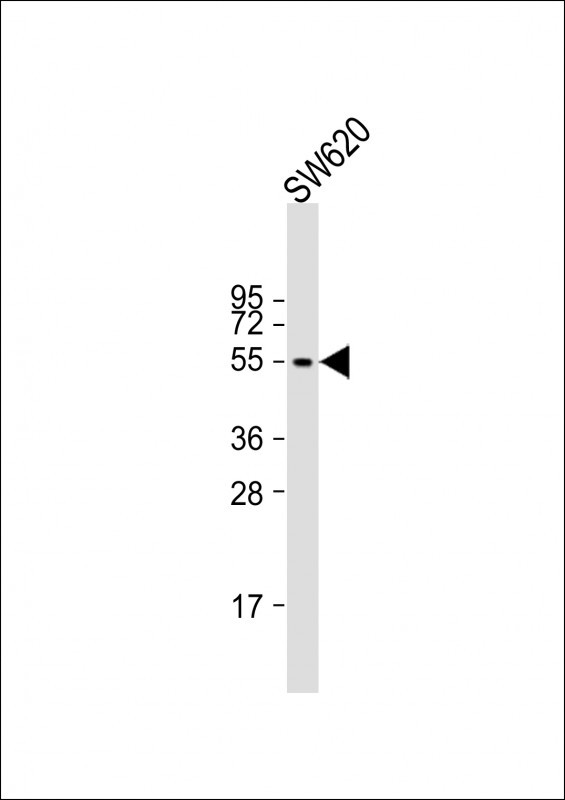
Western Blot at 1:2000 dilution + SW620 whole cell lysate Lysates/proteins at 20 ug per lane.Application
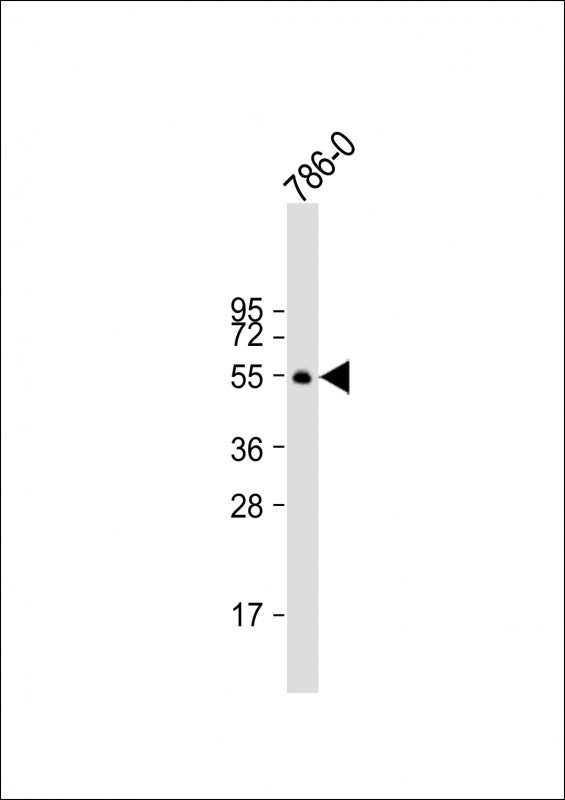
Western Blot at 1:2000 dilution + 786-0 whole cell lysate Lysates/proteins at 20 ug per lane.| Product Name | CA9 Antibody |
|---|---|
| Antibody Type | Primary Antibodies |
| Product description | Carbonic anhydrases (CAs) are a large family of zinc metalloenzymes that catalyze the reversible hydration of carbon dioxide. They participate in a variety of biological processes, including respiration, calcification, acid-base balance, bone resorption, and the formation of aqueous humor, cerebrospinal fluid, saliva, and gastric acid. They show extensive diversity in tissue distribution and in their subcellular localization. CA IX is a transmembrane protein and the only tumor-associated carbonic anhydrase isoenzyme known. It is expressed in all clear-cell renal cell carcinoma, but is not detected in normal kidney or most other normal tissues. It may be involved in cell proliferation and transformation. This gene was mapped to 17q21.2 by fluorescence in situ hybridization, however, radiation hybrid mapping localized it to 9p13-p12.1) Grabmaier, K., et al., Oncogene 23(33):5624-5631 (2004). Kaluzova, M., et al., Mol. Cell. Biol. 24(13):5757-5766 (2004). Span, P.N., et al., Br. J. Cancer 89(2):271-276 (2003). Hedley, D., et al., Clin. Cancer Res. 9(15):5666-5674 (2003). Bui, M.H., et al., Clin. Cancer Res. 9(2):802-811 (2003). |
| Immunogen | This CA9 antibody is generated from rabbits immunized with a KLH conjugated synthetic peptide between 63-90 amino acids from the N-terminal region of human CA9. |
| Clonality | Polyclonal |
|---|---|
| Isotype | Ig |
| Host Species | Rabbit |
| Tested Applications | WB |
| For WB starting dilution is: 1:2000: |
|
| Species Reactivity | Human |
| Concentration | 1mg/ml |
| Gene Symbol | CA9 |
|---|---|
| Alternative Names | Carbonic anhydrase 9 Carbonate dehydratase IX Carbonic anhydrase IX CA-IX CAIX Membrane antigen MN P54/58N Renal cell carcinoma-associated antigen G250 RCC-associated antigen G250 pMW1 CA9 G250 MN |
| Molecular Weight(MW) | 50 kDa |
Application
Western Blot at 1:2000 dilution + SW620 whole cell lysate Lysates/proteins at 20 ug per lane.
Application
Western Blot at 1:2000 dilution + 786-0 whole cell lysate Lysates/proteins at 20 ug per lane.| Application Notes | For WB starting dilution is: 1:2000: |
|---|
| Form | Liquid |
|---|---|
| Storage Instructions | Store at 4˚C for three months and -20˚C, stable for up to one year. As with all antibodies care should be taken to avoid repeated freeze thaw cycles. Antibodies should not be exposed to prolonged high temperatures. |
| Storage Buffer | Supplied in PBS with 0.09% (W/V) sodium azide. |


