Application
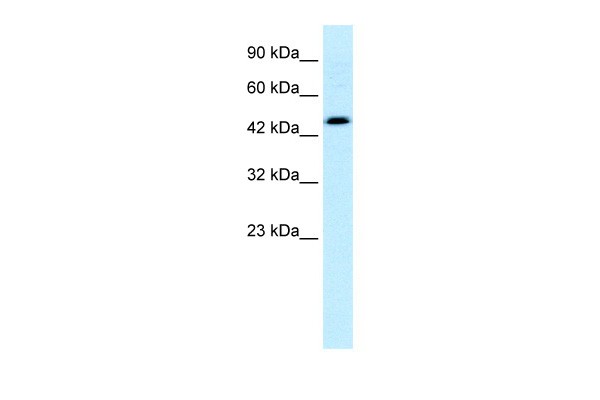
Antibody used in WB on Human HepG2 cells at 0.2-1 ug/ml.| Product Name | CALR Antibody |
|---|---|
| Antibody Type | Primary Antibodies |
| Product description | Calreticulin is a multifunctional protein that acts as a major Ca (2+)-binding (storage) protein in the lumen of the endoplasmic reticulum. It is also found in the nucleus, suggesting that it may have a role in transcription regulation. Calreticulin binds to the synthetic peptide KLGFFKR, which is almost identical to an amino acid sequence in the DNA-binding domain of the superfamily of nuclear receptors. Calreticulin binds to antibodies in certain sera of systemic lupus and Sjogren patients which contain anti-Ro/SSA antibodies, it is highly conserved among species, and it is located in the endoplasmic and sarcoplasmic reticulum where it may bind calcium.1) Urade, R., et al., (2004) Biochemistry 43 (27), 8858-8868. |
| Immunogen | Antibody produced in rabbits immunized with a synthetic peptide corresponding a region of human CALR. |
| Clonality | Polyclonal |
|---|---|
| Host Species | Rabbit |
| Tested Applications | ELISAWB |
| CALR antibody can be used for detection of CALR by ELISA at 1:312500. CALR antibody can be used for detection of CALR by western blot at 1.0 μg/mL, and HRP conjugated secondary antibody should be diluted 1:50,000 - 100,000.: |
|
| Species Reactivity | DogHumanMouseRat |
| Concentration | 1mg/ml |
| Purification | Affinity purified |
| Gene Symbol | CALR |
|---|---|
| Alternative Names | CALR RO CRT SSA cC1qR HEL-S-99n |
| Molecular Weight(MW) | 48 kDa |
Application
Antibody used in WB on Human HepG2 cells at 0.2-1 ug/ml.| Application Notes | CALR antibody can be used for detection of CALR by ELISA at 1:312500. CALR antibody can be used for detection of CALR by western blot at 1.0 μg/mL, and HRP conjugated secondary antibody should be diluted 1:50,000 - 100,000.: |
|---|
| Form | Liquid |
|---|---|
| Storage Instructions | For short periods of storage (days) store at 4˚C. For longer periods of storage, store CALR antibody at -20˚C. As with any antibody avoid repeat freeze-thaw cycles. |
| Storage Buffer | Antibody is lyophilized in PBS buffer with 2% sucrose. Add 50 μL of distilled water. Final antibody concentration is 1 mg/mL. |


