Application
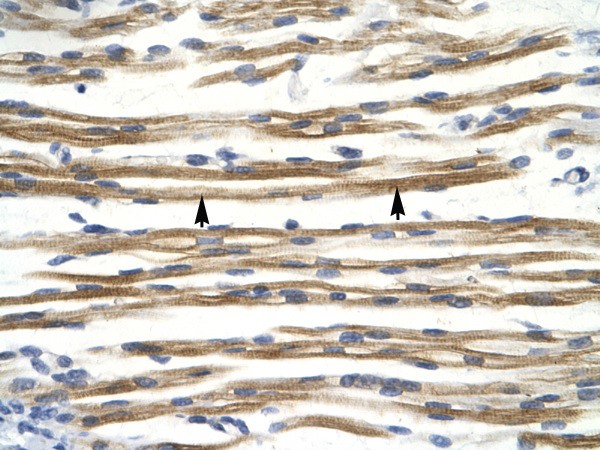
Antibody used in IHC on Human Muscle.Application
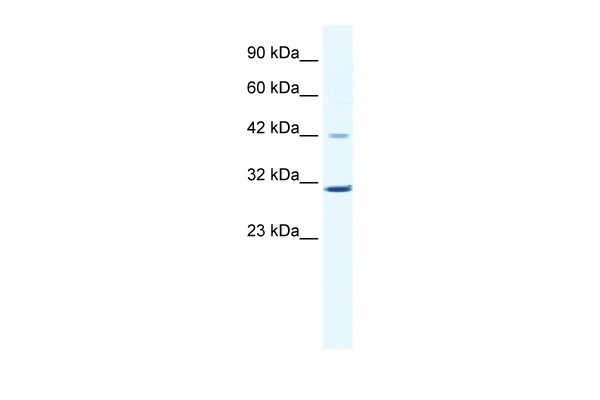
Antibody used in WB on Human Jurkat 0.2-1 ug/ml.| Product Name | CCND3 Antibody |
|---|---|
| Antibody Type | Primary Antibodies |
| Antigen Alias | CCND3, |
| Product description | CCND3 encodes a protein that belongs to the highly conserved cyclin family, whose members are characterized by a dramatic periodicity in protein abundance through the cell cycle. Cyclins function as regulators of CDK kinases. Different cyclins exhibit distinct expression and degradation patterns which contribute to the temporal coordination of each mitotic event. This cyclin forms a complex with and functions as a regulatory subunit of CDK4 or CDK6, whose activtiy is required for cell cycle G1/S transition. This protein has been shown to interact with and be involved in the phosphorylation of tumor suppressor protein Rb. The CDK4 activity associated with this cyclin was reported to be necessary for cell cycle progression through G2 phase into mitosis after UV radiation.1) Pruneri, G., et al., (2004) Int. J. Cancer 112 (1), 71-77. |
| Immunogen | Antibody produced in rabbits immunized with a synthetic peptide corresponding a region of human CCND3. |
| Clonality | Polyclonal |
|---|---|
| Host Species | Rabbit |
| Tested Applications | IHC |
| CCND3 antibody can be used for detection of CCND3 by ELISA at 1:62500. CCND3 antibody can be used for detection of CCND3 by western blot at 0.5 μg/mL, and HRP conjugated secondary antibody should be diluted 1:50,000 - 100,000.: |
|
| Species Reactivity | DogRat |
| Concentration | 1mg/ml |
| Purification | Affinity purified |
| Gene Symbol | CCND3 |
|---|---|
| Alternative Names | CCND3 |
| Molecular Weight(MW) | 33 kDa |
Application
Antibody used in IHC on Human Muscle.
Application
Antibody used in WB on Human Jurkat 0.2-1 ug/ml.| Positive Control | 1) Cat. No. 1205 - Jurkat Cell Lysate |
|---|---|
| Application Notes | CCND3 antibody can be used for detection of CCND3 by ELISA at 1:62500. CCND3 antibody can be used for detection of CCND3 by western blot at 0.5 μg/mL, and HRP conjugated secondary antibody should be diluted 1:50,000 - 100,000.: |
| Form | Liquid |
|---|---|
| Storage Instructions | For short periods of storage (days) store at 4˚C. For longer periods of storage, store CCND3 antibody at -20˚C. As with any antibody avoid repeat freeze-thaw cycles. |
| Storage Buffer | Antibody is lyophilized in PBS buffer with 2% sucrose. Add 50 μL of distilled water. Final antibody concentration is 1 mg/mL. |


