Application
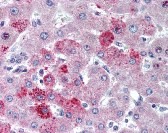
Immunohistochemistry staining of CCR10 in liver tissue using CCR10 Antibody.| Product Name | CCR10 Antibody |
|---|---|
| Antibody Type | Primary Antibodies |
| Antigen Alias | CCR10, C-C CKR-10, CC-CKR-10, CCR-10, C-C chemokine receptor type 10, CC chemokine receptor 10, G-protein coupled receptor 2, GPR2, G protein-coupled receptor 2 |
| Product description | Recently, a function has been assigned to a previously identified orphan chemokine receptor, GPR-2. This receptor, also called CCR10, binds with monocyte chemoattractant protein (MCP)-1, MCP-3 and MIP-1 beta. CCR10 is expressed by melanocytes, dermal fibroblasts, dermal microvascular endothelial cells, T cells as well as in skin-derived Langerhans cells. CCR10 may play a role in both skin homeostasis as well as a potential role in inflammatory responses. GPR2/CCR10, a Chemokine Receptor, encodes a protein that most closely resembles the interleukin-8 receptor. The keratinocyte-produced chemokine CCL27 activates CCR10 and is involved in T cell-mediated skin inflammation. |
| Immunogen | CCR10 antibody was raised against amino acids 350 - 362 of CCR10 (Human). |
| Clonality | Polyclonal |
|---|---|
| Isotype | IgG |
| Host Species | Rabbit |
| Tested Applications | FACSIHCWB |
| CCR10 antibody can be used in immunohistochemistry starting at 15 μg/mL.: |
|
| Species Reactivity | Human |
| Concentration | 1mg/ml |
| Purification | Protein G |
| Gene Symbol | CCR10 |
|---|---|
| Alternative Names | CCR10 C-C CKR-10 CC-CKR-10 CCR-10 C-C chemokine receptor type 10 CC chemokine receptor 10 G-protein coupled receptor 2 GPR2 G protein-coupled receptor 2 |
| Tissue Specificity | In A375, a ~50 kD band is observed. Is made against an epitope in the cytoplasmic domain of the receptor (Moed et al, 2004). For flow cytometry (intracellular) Moed et al fixed cells with 2% formaldehyde and permeabilized with 0.1% saponin. |
Application
Immunohistochemistry staining of CCR10 in liver tissue using CCR10 Antibody.| Application Notes | CCR10 antibody can be used in immunohistochemistry starting at 15 μg/mL.: |
|---|
| Form | Liquid |
|---|---|
| Storage Instructions | CR10 antibody can be stored short term 4 ˚C. For long term storage aliquot and store at -20 ˚C. As with all antibodies avoid freeze/thaw cycles. |
| Storage Buffer | PBS, 0.2% gelatin, 0.05% sodium azide. |


