Application
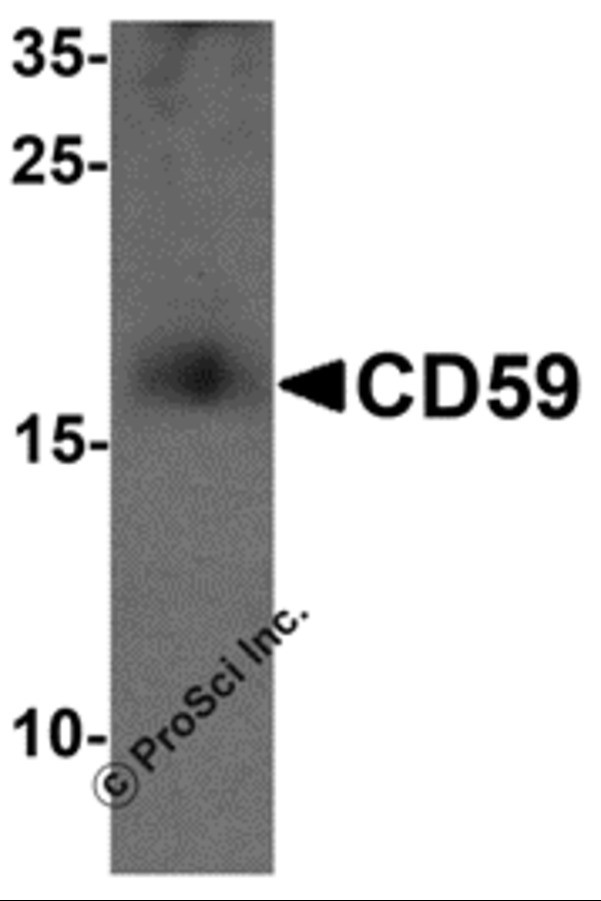
Western blot analysis of CD59 in mouse spleen tissue lysate with CD59 antibody at 1 μg/mL| Product Name | CD59 Antibody |
|---|---|
| Antibody Type | Primary Antibodies |
| Antigen Alias | CD59 Antibody: 1F5, EJ16, EJ30, EL32, G344, MIN1, MIN2, MIN3, MIRL, HRF20, MACIF, MEM43, MIC11, MSK21, 16.3A5, HRF-20, MAC-IP, p18-20, CD59 glycoprotein, 1F5 antigen |
| Product description | CD59 Antibody: The complement regulatory protein CD59 is a cell surface glycoprotein that regulates complement-mediated cell lysis and is involved in lymphocyte signal transduction. CD59 is a potent inhibitor of the complement membrane attack complex, whereby it binds complement C8 and/or C9 during the assembly of this complex, thereby inhibiting the incorporation of multiple copies of C9 into the complex, which is necessary for osmolytic pore formation. CD59 also plays a role in signal transduction pathways in the activation of T cells. Mutations in this gene cause CD59 deficiency, a disease resulting in hemolytic anemia and thrombosis, and ultimately cerebral infarction.1) Venneker GT and Asghar SS. CD59: a molecule involved in antigen presentation as well as downregulation of membrane attack complex. Exp. Clin. Immunogenet. 1992; 9:33-47. |
| Immunogen | Rabbit polyclonal CD59 antibody was raised against a 14 amino acid peptide near the amino terminus of human CD59. The immunogen is located within the first 50 amino acids of CD59. |
| Clonality | Polyclonal |
|---|---|
| Isotype | IgG |
| Host Species | Rabbit |
| Tested Applications | ELISAWB |
| CD59 antibody can be used for detection of CD59 by Western blot at 1 - 2 μg/mL.: |
|
| Species Reactivity | HumanMouse |
| Concentration | 1mg/ml |
| Purification | Affinity purified |
| Gene Symbol | CD59 |
|---|---|
| Alternative Names | CD59 Antibody: 1F5 EJ16 EJ30 EL32 G344 MIN1 MIN2 MIN3 MIRL HRF20 MACIF MEM43 MIC11 MSK21 16.3A5 HRF-20 MAC-IP p18-20 CD59 glycoprotein 1F5 antigen |
| Molecular Weight(MW) | 14 kDa |
| Sequence Similarities | Predicted species reactivity based on immunogen sequence: Pig: (86%) |
Application
Western blot analysis of CD59 in mouse spleen tissue lysate with CD59 antibody at 1 μg/mL| Positive Control | 1) Cat. No. 1406 - Mouse Spleen Tissue Lysate |
|---|---|
| Application Notes | CD59 antibody can be used for detection of CD59 by Western blot at 1 - 2 μg/mL.: |
| Form | Liquid |
|---|---|
| Storage Instructions | CD59 antibody can be stored at 4˚C for three months and -20˚C, stable for up to one year. |
| Storage Buffer | CD59 Antibody is supplied in PBS containing 0.02% sodium azide. |


