Application
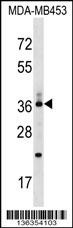
Western blot analysis in MDA-MB453 cell line lysates (35ug/lane).This demonstrates the detected the CD68/CD68 (kpi) protein (arrow).| Product Name | CD68/CD68 Antibody |
|---|---|
| Antibody Type | Primary Antibodies |
| Antigen Alias | Macrosialin, Gp110, CD68, CD68 |
| Product description | This gene encodes a 110-kD transmembrane glycoprotein that is highly expressed by human monocytes and tissue macrophages. It is a member of the lysosomal/endosomal-associated membrane glycoprotein (LAMP) family. The protein primarily localizes to lysosomes and endosomes with a smaller fraction circulating to the cell surface. It is a type I integral membrane protein with a heavily glycosylated extracellular domain and binds to tissue- and organ-specific lectins or selectins. The protein is also a member of the scavenger receptor family. Scavenger receptors typically function to clear cellular debris, promote phagocytosis, and mediate the recruitment and activation of macrophages. Alternative splicing results in multiple transcripts encoding different isoforms.1) Leonarduzzi, G., et al. Mol Nutr Food Res 54 SUPPL 1, S31-S41 (2010) : |
| Immunogen | This CD68/CD68 (kpi) antibody is generated from rabbits immunized with a KLH conjugated synthetic peptide between 209-237 amino acids from the Central region of human CD68/CD68 (kpi). |
| Clonality | Polyclonal |
|---|---|
| Isotype | Ig |
| Host Species | Rabbit |
| Tested Applications | WB |
| For WB starting dilution is: 1:1000: |
|
| Species Reactivity | Human |
| Concentration | 1mg/ml |
| Purification | Affinity purified |
| Gene Symbol | CD68 |
|---|---|
| Alternative Names | Macrosialin Gp110 CD68 CD68 |
| Molecular Weight(MW) | 37 kDa |
Application
Western blot analysis in MDA-MB453 cell line lysates (35ug/lane).This demonstrates the detected the CD68/CD68 (kpi) protein (arrow).| Application Notes | For WB starting dilution is: 1:1000: |
|---|
| Form | Liquid |
|---|---|
| Storage Instructions | Store at 4˚C for three months and -20˚C, stable for up to one year. As with all antibodies care should be taken to avoid repeated freeze thaw cycles. Antibodies should not be exposed to prolonged high temperatures. |
| Storage Buffer | Supplied in PBS with 0.09% (W/V) sodium azide. |


