Application
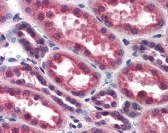
Immunohistochemistry staining of CHUK in kidney tissue using CHUK Antibody.| Product Name | CHUK Antibody |
|---|---|
| Antibody Type | Primary Antibodies |
| Antigen Alias | CHUK, I-kappa-B kinase alpha, I-kappa-B kinase-alpha, Ikb kinase alpha, IKK-A, IKBKA, IKK1, NFKBIKA, I-kappa-B kinase 1, IkappaB kinase, IKK Alpha, IKK-alpha, IKKA, Transcription factor 16, IkappaBalpha Kinase, IkB kinase alpha subunit, IKK-a kinase, Ikkal |
| Product description | NFkB comprises a family of cellular transcription factors that are involved in the inducible expression of a variety of cellular genes that regulate the inflammatory response and control of cell death. In the cytoplasm NFkB is negatively modulated by the inhibitory proteins IkB. In turn IkB is phosphorylated by a cellular kinase complex called IKK. IKK is a heterodimer composed of two kinases: IKK-a and IKK-b that phosphorylate IkB leading to its degradation and the resulting translocation of NFkB to the nucleus. IKK kinase activity is modulated negatively by pharmaceutical agents such as aspirin and positively by various cellular components such as TNF- a, endotoxins and overexpression of cellular kinases like MEKK1. Aspirin appears to have its effect by inhibiting the binding of ATP to IKK. |
| Immunogen | CHUK antibody was raised against a peptide located in the C-Terminus region CHUK (Human). |
| Clonality | Polyclonal |
|---|---|
| Host Species | Rabbit |
| Tested Applications | ELISAIFIHCIPWB |
| CHUK antibody can be used in ELISA, and immunohistochemistry starting at 12 μg/mL.: |
|
| Species Reactivity | HumanMouseRat |
| Concentration | 1mg/ml |
| Purification | Affinity purified |
| Gene Symbol | CHUK |
|---|---|
| Alternative Names | CHUK I-kappa-B kinase alpha I-kappa-B kinase-alpha Ikb kinase alpha IKK-A IKBKA IKK1 NFKBIKA I-kappa-B kinase 1 IkappaB kinase IKK Alpha IKK-alpha IKKA Transcription factor 16 IkappaBalpha Kinase IkB kinase alpha subunit IKK-a kinase Ikkal |
Application
Immunohistochemistry staining of CHUK in kidney tissue using CHUK Antibody.| Application Notes | CHUK antibody can be used in ELISA, and immunohistochemistry starting at 12 μg/mL.: |
|---|
| Form | Liquid |
|---|---|
| Storage Instructions | Store CHUK antibody at -20 ˚C or below prior to opening. Dilute only prior to immediate use. Aliquot contents and freeze at -20 ˚C or below. As with all antibodies avoid freeze/thaw cycles. |
| Storage Buffer | phosphate buffered saline , pH 7.4, 150mM NaCl, 0.02% sodium azide and 50% glycerol. |


