Application
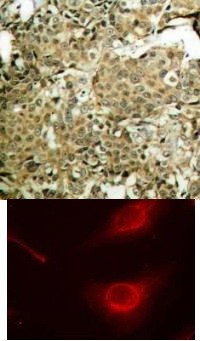
Top Image: Immunohistochemical analysis of paraffin-embedded human breast carcinoma tissue using cofilin (Phospho-Ser3). Bottom Image: Immunofluorescence staining of methanol-fixed HeLa cells using cofilin (Phospho-Ser3).| Product Name | cofilin (phospho Ser3) Antibody |
|---|---|
| Antibody Type | Primary Antibodies |
| Antigen Alias | CFL, HEL-S-15, HER2, MLN19, NEU, NGL, CFL, CFL1 |
| Product description | Controls reversibly actin polymerization and depolymerization in a pH-sensitive manner. It has the ability to bind G- and F-actin in a 1:1 ratio of cofilin to actin. It is the major component of intranuclear and cytoplasmic actin rods.1) Kobayashi M, et al. (2006) EMBO J 25 (4): 713-26. Wang Y, et al. (2005) Biol Chem 280 (13): 12683-9. Smith-Beckerman DM, et al. (2005) Mol Cell Proteomics: 156-68. |
| Immunogen | cofilin (Phospho-Ser3) antibody was raised against a peptide sequence around phosphorylation site of serine 3 (M-A-S (p) -G-V) derived from Human cofilin. |
| Modification | p-Ser3 |
| Clonality | Polyclonal |
|---|---|
| Host Species | Rabbit |
| Tested Applications | IFIHC |
| Western Blot: 1:500~1:1000, Immunohistochemistry: 1:50~1:100, Immunofluorescence: 1:100~1:200: |
|
| Species Reactivity | MouseRat |
| Concentration | 1mg/ml |
| Purification | Affinity purified |
| Gene Symbol | CFL1 |
|---|---|
| Alternative Names | CFL HEL-S-15 HER2 MLN19 NEU NGL CFL CFL1 |
| Molecular Weight(MW) | 19 kDa |
| Tissue Specificity | This antibody detects endogenous level of cofilin only when phosphorylated at serine 3. |
| Entrez Gene | 1072 |
|---|---|
| Protein Accession | NP_005498.1 |
Application
Top Image: Immunohistochemical analysis of paraffin-embedded human breast carcinoma tissue using cofilin (Phospho-Ser3). Bottom Image: Immunofluorescence staining of methanol-fixed HeLa cells using cofilin (Phospho-Ser3).| Application Notes | Western Blot: 1:500~1:1000, Immunohistochemistry: 1:50~1:100, Immunofluorescence: 1:100~1:200: |
|---|
| Form | Liquid |
|---|---|
| Storage Instructions | Store antibody at -20˚C for up to one year. |
| Storage Buffer | Antibody supplied in phosphate buffered saline (without Mg2+ and Ca2+), pH 7.4, 150mM NaCl, 0.02% sodium azide and 50% glycerol. |


