Application
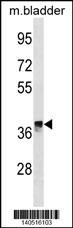
Western blot analysis in mouse bladder tissue lysates (35ug/lane).| Product Name | CRYM Antibody |
|---|---|
| Antibody Type | Primary Antibodies |
| Product description | Crystallins are separated into two classes: taxon-specific and ubiquitous. The former class is also called phylogenetically-restricted crystallins. The latter class constitutes the major proteins of vertebrate eye lens and maintains the transparency and refractive index of the lens. This gene encodes a taxon-specific crystallin protein that binds NADPH and has sequence similarity to bacterial ornithine cyclodeaminases. The encoded protein does not perform a structural role in lens tissue, and instead it binds thyroid hormone for possible regulatory or developmental roles. Mutations in this gene have been associated with autosomal dominant non-syndromic deafness. Multiple alternatively spliced transcript variants have been found for this gene.1) Martins-de-Souza, D., et al.Psychiatr Res (2010) In press : |
| Immunogen | This CRYM antibody is generated from rabbits immunized with a KLH conjugated synthetic peptide between 154-183 amino acids from the Central region of human CRYM. |
| Clonality | Polyclonal |
|---|---|
| Isotype | Ig |
| Host Species | Rabbit |
| Tested Applications | WB |
| For WB starting dilution is: 1:1000 | |
| Species Reactivity | Mouse |
| Concentration | 1mg/ml |
| Purification | Affinity purified |
| Gene Symbol | CRYM |
|---|---|
| Alternative Names | Ketimine reductase mu-crystallin NADP-regulated thyroid-hormone-binding protein CRYM THBP |
| Molecular Weight(MW) | 34 kDa |
Application
Western blot analysis in mouse bladder tissue lysates (35ug/lane).| Application Notes | For WB starting dilution is: 1:1000 |
|---|
| Form | Liquid |
|---|---|
| Storage Instructions | Store at 4˚C for three months and -20˚C, stable for up to one year. As with all antibodies care should be taken to avoid repeated freeze thaw cycles. Antibodies should not be exposed to prolonged high temperatures. |
| Storage Buffer | Supplied in PBS with 0.09% (W/V) sodium azide. |


