Application
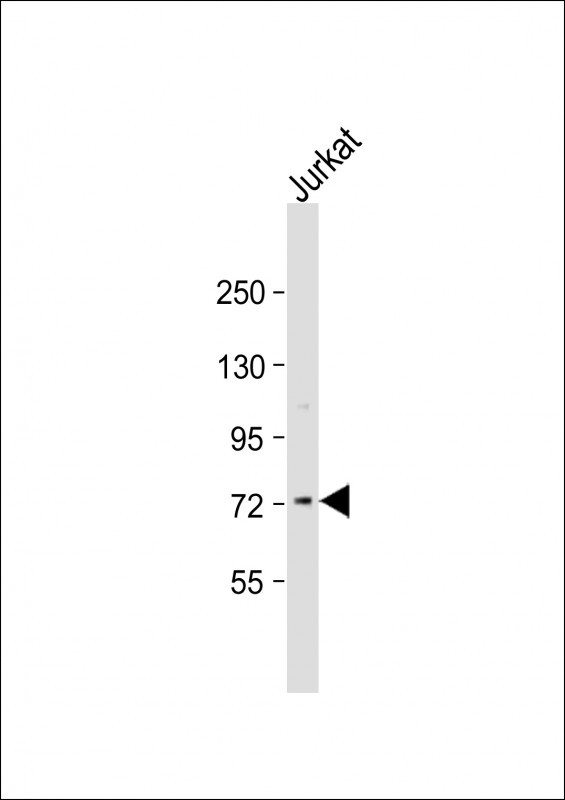
Western Blot at 1:2000 dilution + Jurkat whole cell lysate Lysates/proteins at 20 ug per lane.| Product Name | CTCFL Antibody |
|---|---|
| Antibody Type | Primary Antibodies |
| Product description | Testis-specific DNA binding protein responsible for insulator function, nuclear architecture and transcriptional control, which probably acts by recruiting epigenetic chromatin modifiers. Plays a key role in gene imprinting in male germline, by participating in the establishment of differential methylation at the IGF2/H19 imprinted control region (ICR). Directly binds the unmethylated H19 ICR and recruits the PRMT7 methyltransferase, leading to methylate histone H4 'Arg-3' to form H4R3sme2. This probably leads to recruit de novo DNA methyltransferases at these sites (By similarity). Seems to act as tumor suppressor. In association with DNMT1 and DNMT3B, involved in activation of BAG1 gene expression by binding to its promoter. Required for dimethylation of H3 lysine 4 (H3K4me2) of MYC and BRCA1 promoters.1) Loukinov D.I.,et al.Proc. Natl. Acad. Sci. U.S.A. 99:6806-6811(2002). |
| Immunogen | This CTCFL antibody is generated from a rabbit immunized with a KLH conjugated synthetic peptide between 617-650 amino acids from human CTCFL. |
| Clonality | Polyclonal |
|---|---|
| Isotype | Ig |
| Host Species | Rabbit |
| Tested Applications | WB |
| For WB starting dilution is: 1:2000 | |
| Species Reactivity | Human |
| Concentration | 1mg/ml |
| Purification | Affinity purified |
| Gene Symbol | CTCFL |
|---|---|
| Alternative Names | Transcriptional repressor CTCFL Brother of the regulator of imprinted sites CCCTC-binding factor CTCF paralog CTCF-like protein Cancer/testis antigen 27 CT27 Zinc finger protein CTCF-T CTCFL BORIS |
| Molecular Weight(MW) | 76 kDa |
Application
Western Blot at 1:2000 dilution + Jurkat whole cell lysate Lysates/proteins at 20 ug per lane.| Application Notes | For WB starting dilution is: 1:2000 |
|---|
| Form | Liquid |
|---|---|
| Storage Instructions | Store at 4˚C for three months and -20˚C, stable for up to one year. As with all antibodies care should be taken to avoid repeated freeze thaw cycles. Antibodies should not be exposed to prolonged high temperatures. |
| Storage Buffer | Supplied in PBS with 0.09% (W/V) sodium azide. |


