Application
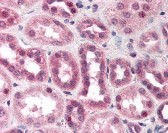
Immunohistochemistry staining of CUL5 in kidney tissue using CUL5 Antibody.| Product Name | Cullin 5 Antibody |
|---|---|
| Antibody Type | Primary Antibodies |
| Product description | Cullins assemble a potentially large number of ubiquitin ligases by binding to the RING protein ROC1 to catalyse polyubiquitination, as well as binding to various specificity factors to recruit substrates. Cullin 5 is a component of E3 ubiquitin ligase complexes, which mediate the ubiquitination and subsequent proteasomal degradation of target proteins. Cullin 5 seems to be involved proteosomal degradation of p53/TP53 stimulated by adenovirus E1B-55 kDa protein. Cullin 5 may form a cell surface vasopressin receptor. Cullin 5 is part of a E3 ubiquitin ligase complex with elongin BC complex (TCEB1 and TCEB2), RBX1 and MUF1, complexes with elongin BC complex (TCEB1 and TCEB2), RXB1 and TCEB3 or SOCS1 or WSB1; elongin BC complex (TCEB1 and TCEB2), RBX1 and VHL; elongin BC complex (TCEB1 and TCEB2), RBX1, adenovirus type 5 E1B-55 kDa protein and adenovirus type 5 E4-orf6. Cullin 5 Interacts with RBX1 and RNF7. |
| Immunogen | Cullin 5 antibody was raised against amino acids 4 - 18 of Cullin 5 (Human) that was coupled to KLH. |
| Clonality | Polyclonal |
|---|---|
| Host Species | Rabbit |
| Tested Applications | ELISAIHCIPWB |
| Cullin 5 antibody can be used in ELISA starting at 1:000 - 1:1000, and immunohistochemistry starting at 10 μg/mL. | |
| Species Reactivity | Human |
| Concentration | 1mg/ml |
| Purification | Affinity purified |
| Gene Symbol | CUL5 |
|---|---|
| Alternative Names | CUL5 Cullin 5 CUL-5 VACM-1 VACM1 Cullin-5 |
Application
Immunohistochemistry staining of CUL5 in kidney tissue using CUL5 Antibody.| Application Notes | Cullin 5 antibody can be used in ELISA starting at 1:000 - 1:1000, and immunohistochemistry starting at 10 μg/mL. |
|---|
| Form | Liquid |
|---|---|
| Storage Instructions | Store Cullin 5 antibody at 4 ˚C or -20 ˚C. As with all antibodies avoid freeze/thaw cycles. |
| Storage Buffer | 0.01% sodium azide. |


