Application
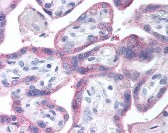
Immunohistochemistry staining of EGF receptor in placenta tissue using EGF receptor Antibody.| Product Name | EGF Receptor Antibody |
|---|---|
| Antibody Type | Primary Antibodies |
| Antigen Alias | EGFR, EGFf receptor, ERBB, ERBB1, MENA, Panitumumab, PIG61, Proto-oncogene c-ErbB-1, V-erb-b homolog, EGF-R, HER1 |
| Product description | EGFR is a transmembrane glycoprotein that is a member of a family of protein tyrosine kinases crucial in maintaining a normal balance in cell growth and development. Growth factor receptors are involved not only in promoting the proliferation of normal cells but also in the aberrant growth of many types of human tumors. For example, the epidermal growth factor receptor (EGFR) is mutated and/or overexpressed in many common solid human squamous cell carcinomas including breast, brain, bladder, lung, gastric, head & neck, esophagus, cervix, vulva, ovary, and endometrium. Over-expression of the EGFR gene occurs in carcinomas with and without gene amplification. EGFR and erbB-2 are particularly important in breast cancer because increased production or activation has been associated with poor prognosis. EGFR belongs to a family of growth factor receptors, which also includes ErbB-2/HER-2/neu, ErbB-3/HER-3/neu and ErbB-4/HER-4neu. EGFR can heterodimerize with each of the members of this family. |
| Immunogen | EGF Receptor antibody was raised against amino acids 1189 - 1199 of EGF Receptor (Human). |
| Clonality | Polyclonal |
|---|---|
| Host Species | Rabbit |
| Tested Applications | ELISAIHCWB |
| EGF Receptor antibody can be used in Western Blot starting at 0.5 - 4 μg/mL, immunohistochemistry starting at 5 μg/mL, and immunoprecipitation.: |
|
| Species Reactivity | HumanMouseRat |
| Concentration | 1mg/ml |
| Gene Symbol | EGFR |
|---|---|
| Alternative Names | EGFR EGFf receptor ERBB ERBB1 MENA Panitumumab PIG61 Proto-oncogene c-ErbB-1 V-erb-b homolog EGF-R HER1 |
Application
Immunohistochemistry staining of EGF receptor in placenta tissue using EGF receptor Antibody.| Application Notes | EGF Receptor antibody can be used in Western Blot starting at 0.5 - 4 μg/mL, immunohistochemistry starting at 5 μg/mL, and immunoprecipitation.: |
|---|
| Form | Liquid |
|---|---|
| Storage Instructions | Store EGF Receptor antibody at 4 ˚C or -20 ˚C. As with all antibodies avoid freeze/thaw cycles. |
| Storage Buffer | 0.02 M potassium phosphate, 0.15 M sodium chloride, pH 7.2, 0.01% sodium azide. |


