Application
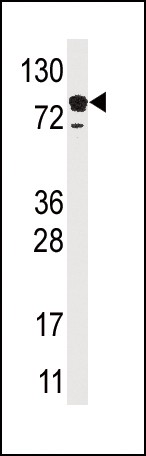
Western blot analysis of anti-EPS15 Pab in HL60 cell line lysate (35ug/lane)| Product Name | EPS15 Antibody |
|---|---|
| Antibody Type | Primary Antibodies |
| Antigen Alias | Epidermal growth factor receptor substrate 15, Protein Eps15, Protein AF-1p, EPS15, AF1P |
| Product description | EPS15 is involved in cell growth regulation, possibly via the regulation of mitogenic signals and control of cell proliferation. EPS15 also participates in the internalization of ligand-inducible receptors of the receptor tyrosine kinase (RTK) type, in particular EGFR. Potential interaction partners include AP2A2, STN2, EPN1, and CRK via its SH3-binding sites. EPS15 is ubiquitously expressed. Phosphorylation on Tyr-849 is involved in the internalization of EGFR. EPS15 is not required for membrane translocation after EGF treatment or for targeting to coated pits, but essential for a subsequent step in EGFR endocytosis. This protein is involved in a t(1;11)(p32;q23) chromosomal translocation in acute leukemias causing fusion to the trithorax (MLL or HRX) gene product which contains DNA-binding motifs resulting in a rogue activator protein. Structurally, EPS15 contains 2 EF-hand calcium-binding domains, 3 EH domains, and 2 ubiquitin-interacting motif (UIM) repeats.1) de Beer, T., et al., Nat. Struct. Biol. 7(11):1018-1022 (2000). |
| Immunogen | This EPS15 antibody is generated from rabbits immunized with a KLH conjugated synthetic peptide between 840-870 amino acids from the C-terminal region of human EPS15. |
| Clonality | Polyclonal |
|---|---|
| Isotype | Ig |
| Host Species | Rabbit |
| Tested Applications | WB |
| For WB starting dilution is: 1:1000: |
|
| Species Reactivity | Human |
| Concentration | 1mg/ml |
| Gene Symbol | EPS15 |
|---|---|
| Alternative Names | Epidermal growth factor receptor substrate 15 Protein Eps15 Protein AF-1p EPS15 AF1P |
| Molecular Weight(MW) | 99 kDa |
| Sequence Similarities | Predicted species reactivity based on immunogen sequence: Mouse |
Application
Western blot analysis of anti-EPS15 Pab in HL60 cell line lysate (35ug/lane)| Application Notes | For WB starting dilution is: 1:1000: |
|---|
| Form | Liquid |
|---|---|
| Storage Instructions | Store at 4˚C for three months and -20˚C, stable for up to one year. As with all antibodies care should be taken to avoid repeated freeze thaw cycles. Antibodies should not be exposed to prolonged high temperatures. |
| Storage Buffer | Supplied in PBS with 0.09% (W/V) sodium azide. |


