Application
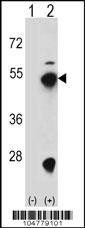
Western blot analysis of FDPS using rabbit polyclonal FDPS Antibody (D31) using 293 cell lysates (2 ug/lane) either nontransfected (Lane 1) or transiently transfected (Lane 2) with the FDPS gene.| Product Name | FDPS Antibody |
|---|---|
| Antibody Type | Primary Antibodies |
| Product description | The isoprene biosynthetic pathway supply the cell with cholesterol, ubiquinone, and various nonsterol metabolites. The farnesylpyrophosphate synthetase enzyme catalyzes the formation of geranyl and farnesylpyrophosphate from isopentenylpyrophosphate and dimethylallyl pyrophosphate. Analysis of FDPS activity and protein in rat liver, accompanied by immunofluorescence and immunoelectron microscopy studies, demonstrated that FDPS is predominantly localized in peroxisomes.1 Liver tissue from patients with the peroxisomal deficiency diseases Zellweger syndrome and neonatal adrenoleukodystrophy exhibit diminished activities of FDPS and subsequent isoprenoid synthesis.1) Strausberg, R.L., et al., Proc. Natl. Acad. Sci. U.S.A. 99(26):16899-16903 (2002). |
| Immunogen | This FDPS antibody is generated from rabbits immunized with a KLH conjugated synthetic peptide between 82-112 amino acids from the N-terminal region of human FDPS. |
| Clonality | Polyclonal |
|---|---|
| Isotype | Ig |
| Host Species | Rabbit |
| Tested Applications | IHC-PWB |
| For IF starting dilution is: 1:100 For IHC-P starting dilution is: 1:50~100 For WB starting dilution is: 1:1000 | |
| Species Reactivity | Human |
| Concentration | 1mg/ml |
| Purification | Unpurified |
| Gene Symbol | FDPS |
|---|---|
| Alternative Names | Farnesyl pyrophosphate synthase FPP synthase FPS (2E 6E)-farnesyl diphosphate synthase Dimethylallyltranstransferase Farnesyl diphosphate synthase Geranyltranstransferase FDPS FPS KIAA1293 |
| Molecular Weight(MW) | 48 kDa |
Application
Western blot analysis of FDPS using rabbit polyclonal FDPS Antibody (D31) using 293 cell lysates (2 ug/lane) either nontransfected (Lane 1) or transiently transfected (Lane 2) with the FDPS gene.| Application Notes | For IF starting dilution is: 1:100 For IHC-P starting dilution is: 1:50~100 For WB starting dilution is: 1:1000 |
|---|
| Form | Liquid |
|---|---|
| Storage Instructions | Store at 4˚C for three months and -20˚C, stable for up to one year. As with all antibodies care should be taken to avoid repeated freeze thaw cycles. Antibodies should not be exposed to prolonged high temperatures. |
| Storage Buffer | Supplied in PBS with 0.09% (W/V) sodium azide. |


