Application
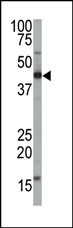
Antibody is used in Western blot to detect FNTA in mouse brain tissue lysate.| Product Name | FNTA Antibody |
|---|---|
| Antibody Type | Primary Antibodies |
| Antigen Alias | Protein farnesyltransferase/geranylgeranyltransferase type-1 subunit alpha, CAAX farnesyltransferase subunit alpha, FTase-alpha, Ras proteins prenyltransferase subunit alpha, Type I protein geranyl-geranyltransferase subunit alpha, GGTase-I-alpha, FNTA |
| Product description | FNTA, also known as CAAX farnesyltransferase (FTase), attaches a farnesyl group from farnesyl pyrophosphate to cysteine residues at the fourth position from the C terminus of proteins that end in the so-called CAAX box, where C is cysteine, A is usually but not always an aliphatic amino acid, and X is typically methionine or serine. This type of posttranslational modification provides a mechanism for membrane localization of proteins that lack a transmembrane domain. This enzyme has the remarkable property of farnesylating peptides as short as four residues in length that conform to the CAAX consensus sequence. FNTA is also a specific cytoplasmic interactor of the transforming growth factor-beta and activin type I receptors. It is likely to be a key component of the signaling pathway which involves p21ras, an important substrate for farnesyltransferase.1) Wang, T., et al., Science 271(5252):1120-1122 (1996). |
| Immunogen | This FNTA antibody is generated from rabbits immunized with a KLH conjugated synthetic peptide between 88-118 amino acids from the Central region of human FNTA. |
| Clonality | Polyclonal |
|---|---|
| Isotype | Ig |
| Host Species | Rabbit |
| Tested Applications | WB |
| For WB starting dilution is: 1:1000: |
|
| Species Reactivity | HumanMouse |
| Concentration | 1mg/ml |
| Gene Symbol | FNTA |
|---|---|
| Alternative Names | Protein farnesyltransferase/geranylgeranyltransferase type-1 subunit alpha CAAX farnesyltransferase subunit alpha FTase-alpha Ras proteins prenyltransferase subunit alpha Type I protein geranyl-geranyltransferase subunit alpha GGTase-I-alpha FNTA |
| Molecular Weight(MW) | 44 kDa |
| Sequence Similarities | Predicted species reactivity based on immunogen sequence: Bovine |
Application
Antibody is used in Western blot to detect FNTA in mouse brain tissue lysate.| Application Notes | For WB starting dilution is: 1:1000: |
|---|
| Form | Liquid |
|---|---|
| Storage Instructions | Store at 4˚C for three months and -20˚C, stable for up to one year. As with all antibodies care should be taken to avoid repeated freeze thaw cycles. Antibodies should not be exposed to prolonged high temperatures. |
| Storage Buffer | Supplied in PBS with 0.09% (W/V) sodium azide. |


