Application
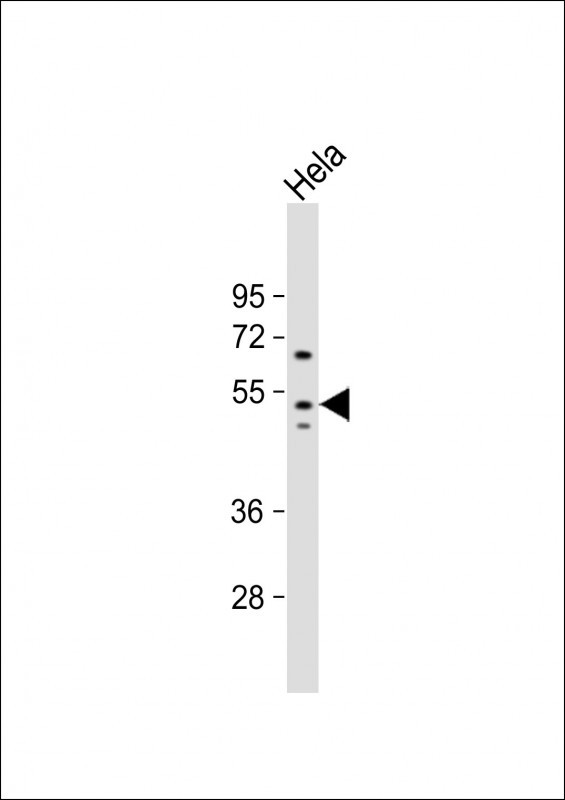
Western Blot at 1:1000 dilution + Hela whole cell lysate Lysates/proteins at 20 ug per lane.| Product Name | GSK3A Antibody |
|---|---|
| Antibody Type | Primary Antibodies |
| Antigen Alias | Glycogen synthase kinase-3 alpha, GSK-3 alpha, Serine/threonine-protein kinase GSK3A, GSK3A |
| Product description | Glycogen synthase kinase 3-alpha (GSK3A)is a multifunctional protein serine kinase implicated in the control of several regulatory proteins including glycogen synthase and transcription factors. It also plays a role in the WNT and PI3K signaling pathways. Under resting conditions GSK3A and its homologs are highly phosphorylated at tyr279 in the phosphorylation loop. Constitutive phosphorylation of this tyrosine is important for kinase activity. Dephosphorylation of tyr279 after mitogen activation is accompanied by kinase inactivation. PKA as well as PI3K-activated PKB inactivate GSK3A by phosphorylation at ser21. Lysophosphatidic acid primarily utilizes a PKC-dependent pathway to modulate GSK3 and certain growth factors (e.g., PDGFB), which control GSK3 mainly through PIK3-PKB, are able to regulate GSK3 through an alternative, redundant PKC pathway. In mice expressing familial AD-associated mutations in APP and PSEN1, lithium reduced the levels of beta-amyloid peptides GSK3A also phosphorylates the tau protein, the principal component of neurofibrillary tangles in AD, and suggested that inhibition of GSK3A may offer a new therapeutic approach to AD.1) Strausberg, R.L., et al., Proc. Natl. Acad. Sci. U.S.A. 99(26):16899-16903 (2002). |
| Immunogen | This GSK3A antibody is generated from rabbits immunized with a KLH conjugated synthetic peptide selected from amino acid residues surrounding S21 of human GSK3A. |
| Clonality | Polyclonal |
|---|---|
| Isotype | Ig |
| Host Species | Rabbit |
| Tested Applications | WB |
| For WB starting dilution is: 1:1000: |
|
| Species Reactivity | Human |
| Concentration | 1mg/ml |
| Purification | Affinity purified |
| Gene Symbol | GSK3A |
|---|---|
| Alternative Names | Glycogen synthase kinase-3 alpha GSK-3 alpha Serine/threonine-protein kinase GSK3A GSK3A |
| Molecular Weight(MW) | 51 kDa |
| Sequence Similarities | Predicted species reactivity based on immunogen sequence: Mouse |
Application
Western Blot at 1:1000 dilution + Hela whole cell lysate Lysates/proteins at 20 ug per lane.| Application Notes | For WB starting dilution is: 1:1000: |
|---|
| Form | Liquid |
|---|---|
| Storage Instructions | Store at 4˚C for three months and -20˚C, stable for up to one year. As with all antibodies care should be taken to avoid repeated freeze thaw cycles. Antibodies should not be exposed to prolonged high temperatures. |
| Storage Buffer | Supplied in PBS with 0.09% (W/V) sodium azide. |


