Application
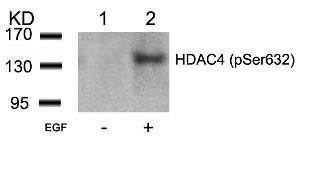
Western blot analysis of lysed extracts from 293 cells untreated (Lane 1) or treated with EGF (lane 2) using HDAC4 (Phospho-Ser632).| Product Name | HDAC4 (phospho Ser632) Antibody |
|---|---|
| Antibody Type | Primary Antibodies |
| Product description | Responsible for the deacetylation of lysine residues on the N-terminal part of the core histones (H2A, H2B, H3 and H4). Histone deacetylation gives a tag for epigenetic repression and plays an important role in transcriptional regulation, cell cycle progression and developmental events. Histone deacetylases act via the formation of large multiprotein complexes. Involved in muscle maturation via its interaction with the myocyte enhancer factors such as MEF2A, MEF2C and MEF2D.1) Wang AH, et al. (2000) Mol Cell Biol. 20 (18): 6904-6912. Grozinger CM, et al. (2000) Proc Natl Acad Sci U S A. 97 (14): 7835-7840. |
| Immunogen | HDAC4 (Phospho-Ser632) antibody was raised against a peptide sequence around phosphorylation site of serine 632 (A-Q-S (p) -S-P) derived from Human HDAC4. |
| Modification | p-Ser632 |
| Clonality | Polyclonal |
|---|---|
| Host Species | Rabbit |
| Tested Applications | WB |
| Western Blot: 1:500~1:1000 | |
| Species Reactivity | HumanMouseRat |
| Concentration | 1mg/ml |
| Purification | Affinity purified |
| Gene Symbol | HDAC4 |
|---|---|
| Alternative Names | HD4 AHO3 BDMR HDACA HA6116 HDAC-4 HDAC-A AML1 CBFA2 HD4 |
| Molecular Weight(MW) | 140 kDa |
| Tissue Specificity | This antibody detects endogenous level of HDAC4 only when phosphorylated at serine 632. |
| Entrez Gene | 9759 |
|---|---|
| Protein Accession | NP_006028.2 |
Application
Western blot analysis of lysed extracts from 293 cells untreated (Lane 1) or treated with EGF (lane 2) using HDAC4 (Phospho-Ser632).| Application Notes | Western Blot: 1:500~1:1000 |
|---|
| Form | Liquid |
|---|---|
| Storage Instructions | Store antibody at -20˚C for up to one year. |
| Storage Buffer | Antibody supplied in phosphate buffered saline (without Mg2+ and Ca2+), pH 7.4, 150mM NaCl, 0.02% sodium azide and 50% glycerol. |


