Application
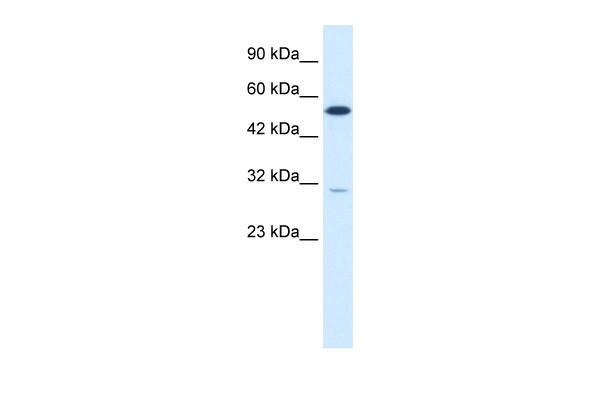
Antibody used in WB on Human Daudi at 0.2-1 ug/ml.| Product Name | HNF4G Antibody |
|---|---|
| Antibody Type | Primary Antibodies |
| Antigen Alias | HNF4G, NR2A2, NR2A3 |
| Product description | HNF4 was first identified as a DNA binding activity in rat liver nuclear extracts and then was found to be an orphan member of the nuclear receptor superfamily. Binding sites for this factor were identified in many tissue-specifically expressed genes, and the protein was found to be essential for early embryonic development in the mouse1) Ozeki, T., et al., (2003) Pharmacogenetics 13 (1), 49-53. |
| Immunogen | Antibody produced in rabbits immunized with a synthetic peptide corresponding a region of human HNF4G. |
| Clonality | Polyclonal |
|---|---|
| Host Species | Rabbit |
| Tested Applications | ELISAWB |
| HNF4G antibody can be used for detection of HNF4G by ELISA at 1:62500. HNF4G antibody can be used for detection of HNF4G by western blot at 1.0 μg/mL, and HRP conjugated secondary antibody should be diluted 1:50,000 - 100,000.: |
|
| Species Reactivity | DogHumanRat |
| Concentration | 1mg/ml |
| Purification | Affinity purified |
| Gene Symbol | HNF4G |
|---|---|
| Alternative Names | HNF4G NR2A2 NR2A3 |
| Molecular Weight(MW) | 46 kDa |
Application
Antibody used in WB on Human Daudi at 0.2-1 ug/ml.| Positive Control | 1) Cat. No. 1224 - Daudi Cell Lysate |
|---|---|
| Application Notes | HNF4G antibody can be used for detection of HNF4G by ELISA at 1:62500. HNF4G antibody can be used for detection of HNF4G by western blot at 1.0 μg/mL, and HRP conjugated secondary antibody should be diluted 1:50,000 - 100,000.: |
| Form | Liquid |
|---|---|
| Storage Instructions | For short periods of storage (days) store at 4˚C. For longer periods of storage, store HNF4G antibody at -20˚C. As with any antibody avoid repeat freeze-thaw cycles. |
| Storage Buffer | Antibody is lyophilized in PBS buffer with 2% sucrose. Add 50 μL of distilled water. Final antibody concentration is 1 mg/mL. |


